




A Clinical Dissertation Presented to the
University of San Francisco
School of Nursing and Health Professions
Health Professions Department
PsyD Program in Clinical Psychology
In Partial Fulfillment of the Requirements for the Degree of
Doctor of Psychology in Clinical Psychology
By,
Smitha Kashi
University of San Francisco 2023
Abstract
This dissertation used a qualitative analysis methodology to study the contributions of parenting styles and peer relationships on the emotional expressivity of second generation Asian Indian-Americans. Seven participants participated in a 60 – 90 minute long semi-structured interview and the content was analyzed using a thematic analysis approach. Most previous research regarding this topic has been conducted on White American or European individuals and does not take into consideration the many intersectionalities that second-generation Indian-Americans hold. Many participants discussed the lack of direction they experienced in regards to learning about their emotions and disclosed that college and young adulthood provided most with corrective emotional experiences. Participants additionally talked about how their parents immigration journey to the United States greatly influenced how they parented the participants. Most participants showed an ability to both understand their parents parenting approaches while also describing a yearning to have emotionally focused conversations. Participants identified the need for more openness about emotions and mental health within the larger South Asian community and shine a light on the mental health stigma they experienced throughout their childhood. They described hoping that the narrative regarding emotional expression, regulation, and disclosure continues to change. It is important to remember that though there are many similarities between these participants, there are significant differences in their experiences. As the South Asian population is one of the largest and quickly growing minority groups in the United States, increasing clinician awareness and understanding regarding potential difficulties with emotional vocabulary and emotional processing that this group may experience is essential. Additionally, due to the negative attitudes towards mental health utilization that exist within this community, clinicians must understand the resiliency required for these individuals to pursue services and the stigma of seeking mental health treatment they might experience both within themselves and from their community. Furthermore, it is imperative that clinicians understand the impacts of immigration on this population and how to best tailor treatment goals to serve these clients.
Acknowledgements
First and foremost, I want to thank my mom, dad, and brother who have supported me and encouraged me to pursue higher education. I have watched how your determination has allowed you to all be successful in your own ways and I have looked up to that in all the times I have felt overwhelmed and wanted to give up. Your resiliency and motivation are so inspiring. Thank you for always pushing me and celebrating my achievements throughout this process.
To my partner, Devon, I do not have the words to express how much I appreciate you standing by me through all the obstacles of graduate school. You have eased my stressors and allowed me to focus on dissertation, practicum, and now internship. My graduate school journey has had so many ups and downs and I will never be able to fully thank you for all your support. Thank you for encouraging me to keep going in the lowest of lows and celebrating my wins just as hard as me. To my two kitties, Tink and Mango, thank you for being constant entertainment during the hardest parts of my graduate school career. You both have made me zoom out and learn to enjoy the small things in life.
Additionally, I want to thank my cohort for pushing me through all of the difficult times. No one will ever understand our journey together and our endless conversations and chats about our shared hardships is a significant part of what got me through this process. You all are so important to me and I would not have wanted to be on this journey with anyone else. I cannot wait to see where life takes us all. I want to especially thank Mellanie and Devon for the constant motivation to reach my goals. Mellanie, our zoom calls have made me feel less alone in this process. Devon, I thank you for your uplifting texts and reminders of the light at the end of the tunnel.
Lastly, I want to thank my dissertation advisor Dr. Meghani. I am so appreciative for all the time you have spent in guiding me and being so supportive and encouraging of my process. Your mentorship during this process has been invaluable and that is something I will forever be grateful for.
Dedication
This dissertation is dedicated to all the second-generation Asian-Indian American individuals who shared their story with me. Thank you for contributing more to understanding how Asian-Indian Americans experience emotions. Your stories were absolutely profound and I feel honored to have heard them.
Chapter 1: Introduction
Specific Aims
Identification of Problem
Alignment with the Jesuit Mission
Brief Rationale
Overview of Approach
Definition of project-specific terms
Chapter 2: Critical Literature Review
Emotional Expression
Emotional Regulation
Parents, Peers, and Emotional Competence
Parenting & Emotional Socialization
Differences between Collectivistic and Individualistic Cultures
Emotional Acculturation
Asian-Indian Parenting and Emotional Socialization.
Association between caregiving in childhood and adulthood emotion regulation
Summary
Chapter 3: Method
Reflexivity Statement
Study Design
IRB Approval Status
Participants
Procedure
Recruitment Interview Debriefing
Data Analysis
Chapter 4: Results
Chapter 5: Discussion
References
Appendices:
Appendix A: Recruitment Flier
Appendix B: Listserv Email Recruitment
Appendix C: Eligibility Screening Questionnaire
Appendix D: Post-Eligibility Screener
Appendix E: Consent Form
Appendix F: Interview Guide
Appendix G: Resource List
Appendix H: Demographic Questionnaire
Appendix I: Final Thematic Map
Chapter 1: Introduction
Specific Aims
The purpose of the proposed qualitative study is to understand the influences and development of emotional expression of second generation Indian Americans. Specifically, the researcher will focus on how parenting styles and peer relationships contribute to emotional expression of second-generation Indian-Americans. The researcher will use the following research questions to guide their exploration on this topic:
1. How do Indian Americans describe their emotional expressivity/regulatory capacities?
2. How do Indian Americans describe the process in which they learned about emotional expression?
3. How do second generation Indian-Americans describe their parent’s parenting styles/customs?
Identification of Problem
According to the 2010 U.S. Census, Asians were “among the largest growing race in the United States” (US Census Bureau, 2010). Further research by Daga & Raval (2018) has demonstrated that Indian Americans represent the “largest of [the] South Asian American group” and has grown remarkably (p. 17) and expected to have a population of two million by the year 2050 (Farver et al., 2002), yet there has been “little research attention…devoted to this group” (Daga & Raval, 2018, p. 17). South Asians include individuals who have ethnic origin in the following countries: Bangladesh, Bhutan, India, Pakistan, Nepal, and Sri Lanka (Daga & Raval, 2018; Karasz et al., 2016, Lubin & Khandai, 2016; Soorkia et al., 2011). Asian-Indians include Indians who immigrated from India or other countries outside of the U.S., as well as citizens of Indian descent who were born in the U.S. Karasz et al., 2020 found that South Asian immigrants have greater prevalence of mental health disorders than what has been previously reported, which largely go unaddressed. Lubin and Khandai (2017) state that the prevalence for “…comorbid mood and anxiety disorders [is]…24.5%” up 3.7% between 2009 and 2017. Research by Lee et al., (2008) found that Asian American young adults reported increased stress in areas such as parental expectations, balancing two cultures, and parental communication. Lee et al., found that Asian American young adults, including Asian-Indian Americans, usually do not “seek professional help for their mental health problems” (p. 144) and generally report relying on people within their communities such as friends and partners (Lee et al., 2008). This low rate of Asian Americans utilizing mental health services has been a consistent pattern (Kim et al., 2007) but it is important to highlight the differences in mental health service utilization between generations. Individuals that were born in the U.S. use mental health services more frequently than immigrants or second-generation individuals (Kim et al., 2007). Asian American second-generation individuals and Asian immigrants showed similarity in their low utilization of mental health services (Kim et al., 2007)
Traditionally, individuals who have been raised with attitudes and beliefs stemming from Indian culture may be less likely to be forthcoming with emotions and internal states as is often encouraged by Western-rooted approaches to psychotherapy (Kapoor et al., 2016; McCord & Raval, 2016). Little is known about how Indian-Americans who are born and/or brought up in the U.S. by immigrant parents learn and internalize social and cultural rules around emotional expression. The steady increase of the Asian-Indian population in the last two decades is not reflected proportionately in empirical research; Asian-Indians in the United States (inclusive of individuals of Indian descent such as Indian-Americans, and Indian immigrants) are underrepresented in psychology literature.
Peer relationships and parenting styles are often linked to development of emotional regulation and expression (Morris et al., 2007; Herd & Spoon, 2021, Kilmes et al., 2014), and may have far-reaching influence into one’s emotional expressivity in adulthood. Emotional regulation is a process that focuses on “modifying the experience or expression of an emotion” (Thompson, 1994) while emotional dysregulation is when the individual has a difficult time managing their emotions in a successful way (Cole et al., 2017). These processes have been explored more extensively with Eurocentric samples than with individuals who identify as Indian or Indian-American. It is essential to gain a better understanding of factors that contribute to the emotional expressivity of Indian-Americans in order to make evidence-based recommendations related to counseling and therapy for individuals who identify with this ethnic group. Based on prior research that has found linkages between peer relationships, parenting, and emotional expression, the researcher proposes to undertake a dissertation that explores these relationships among Indian-American adults.
Alignment with the Jesuit Mission
Studies involving the South Asian diaspora are limited even though Asian Indians are one of the largest growing ethnic minority groups in the United States. This research aims to provide future clinicians insight into understanding the interplay of factors that contribute to emotional expression in adulthood for Indian-Americans and thus pursues the Jesuit values of social justice, commitment to diversity, service, and working with underserved communities.
Asian Indians have not been a group that is historically well represented in the field of psychology and associated scholarly literature; individuals from this group are also underserved in mental health (Soorkia et al., 2010). Cura Personalis, a key value in the Jesuit Mission, translates to having concern and caring for an individual’s personal development as a whole.
Conducting research to improve clinicians’ understanding of emotional expression among second generation Indian Americans contributes to a more holistic view of a person who identifies with this cultural background and is aligned with the notion of care for the whole person (Cura personalis).
Brief Rationale
Emotional expression and emotional regulation in childhood have been studied extensively but seldom within the Indian-American population (McCord & Raval, 2016). Factors such as parenting styles, parent-child relationships, and peer relationships have been found to be major contributing factors to the development of these key skills (Fishman et al., 2014; McCord & Raval, 2016). Parenting styles are a “constellation of attitudes toward the child that are communicated to the child and that, taken together, create an emotional climate in which the parent’s behaviors are expressed” (Barnhart et al., 2012, p. 684). Research (McCord & Raval, 2016) on parenting styles is largely based on samples that reflect dominant cultures in Western societies, and specifically those that identify as White or European origin. Current and previous research “provides an inadequate account of parental emotional socialization…among ethnic minority groups in the United States” (McCord & Raval, 2016, p. 464). Indian culture and society, and by extension, Indian-American culture, maintain that the role of the family and parents is central to child development and outcomes. Parents and elders are meant to be held in high regard and are thought of as the child’s first teachers (McCord & Raval, 2016). Cues and rules regarding emotionality and behavior are conveyed based on the belief that the child is a reflection of the family. Although society is changing and becoming more fluid in its understanding of sex and gender, gender roles and expectations have tended to be fairly rigid in India, which may in turn influence differences in parental socialization of female and male-identified children among Indian immigrant parents (McCord & Raval, 2016, p. 467). Further, research by Kim et al. (1999) states that Asian cultures, including India, value “conformity to norms, emotional self-control, collectivism, family recognition through achievement…” (p. 941). Behaviors that are viewed outside of the norm, such as frequent negative emotional expression and utilization of therapeutic services, are not valued and may be stigmatized (Abdullah & Brown, 2011). Additionally, Asian cultures strongly value emotional self-control and therefore stigmatize counseling due to the amount of emotional expression required to participate (Karasz et al., 2020; Abdullah & Brown, 2011).
In addition to parents providing a significant contribution to socialization of emotions in childhood, peers and social relationships are also influential. The period of adolescence and young adulthood is a prime developmental time as individuals are being introduced to new situations and learning to navigate “social and emotional situations” (Herd & Spoon, 2021) independently. Experiences during adolescence and emerging adulthood have a significant effect on an individual’s emotional expression and regulation abilities in later life (Herd & Spoon, 2021). Further research demonstrates that peer relationships can have lasting effects on how individuals develop emotional regulation and expression capabilities due to the importance put on this area of identity development (Fosco & Grych, 2012; Morris et al., 2007, Thompson, 1994).
This research aims to understand how parenting styles and peer relationships influence emotional expression of Indian-American second generation individuals. This is an understudied topic within this population and age group. These processes of emotional development and influences on emotional expression are longitudinal and there needs to be a better understanding of how these factors, peers and parenting, play a role for this population. Additionally, we also need to understand how immigrant parenting plays a role in the emotional expression of second generation Indian-American individuals. Specifically, how do parenting behaviors (reassurance, praise, ambivalence, anger) towards their child’s emotional expression allow for a range of disclosure between the parent and child? It is important to note that there is very little research that investigates the role of peers between American youth in regards to emotional socialization and regulation. There is even less so within ethnic communities, including Indian-American youth which is why it is important to study this population further. Although this research does not propose to investigate emotional socialization practices among Indian-American families, it takes into consideration Indian values, attitudes, and beliefs imbued upon children during childhood and adolescence through parenting and peer socialization. Additionally, the proposed research would provide a new perspective of the complexity of immigrant parents who originated from a collectivistic country but are raising kids in an individualistic country.
Overview of Approach
This qualitative study was conducted using a semi-structured interview guide (Appendix D). The researcher interviewed 7 participants recruited through convenience and snowball sampling. Participants’ data were analyzed per Braun and Clarke’s (2006) thematic analysis framework. This framework allowed the researcher to derive themes from participant interviews to understand the broader context of experiences on adulthood emotional expression. The collected themes were created to provide a rich representation of the data set. The report provides readers with a story of the data to be understood in a digestible manner reflective of the collected data, while being mindful of each of the participants’ narratives.
Definition of project-specific terms
Indian-American: Individuals of Indian origin/descent who reside in the United States of America (Iyengar & Smith, 2016). This qualitative study will be focusing on this population of individuals ranging from the ages of 18 to 24 years old.
Immigrant: An individual who migrates from their country of origin (India) to a foreign country (The United States of America) to live there permanently (Karasz et al., 2016)
1st generation: Immigrants who migrated to the United States when they were 16 years or older (Lee et al, 2009)
1.5 generation: Immigrants who migrated to the United States before age 16 (Lee et al, 2009)
2nd generation: Individuals who were born in the United States to first generation parents. (Lee et al, 2009). The researcher will be focusing on this generation of individuals that are of Indian-American descent.
Chapter 2: Critical Literature Review
Emotional Expression
Emotional expression has been defined as “observable verbal and nonverbal actions that reflect an affective response or state” (Pollastri et al., 2016 p. 69). Emotional expression serves as an important survival mechanism by helping individuals learn how to interact with other people and how to respond appropriately to environmental cues. Emotions play a significant role in helping guide our behavior to fit the demands of the society that we live in (Haga et al., 2007). In other words, emotions are significant players in helping us function socially, such as creating friendships, motivating us to achieve our goals, help us be open to learning, and inform us of dangers (Haga et al., 2007). Having the capacity to express a range of positive and negative emotions allows us to create bonds with peers as well as other individuals and serves as a form of facilitating relationships. When individuals participate in the “social sharing of emotion” (Pennebaker, 2003), this is one type of verbal disclosure that occurs between individuals in a social relationship (e.g., friends and family), as opposed to disclosure of emotions to professionals such as researchers. There are many factors that contribute to the verbal disclosure (e.g. sharing feelings with family/friends) of an individual’s emotions. Some of these factors include reinforcement of emotional disclosure by one’s social circle, societal expectations, and familial expectations.
Research studies indicate that disclosing and expressing emotions has beneficial effects; individuals who are more forthcoming with express disclosing their emotions have “increased likability, intimacy, and relationship satisfaction” (Pollastri et al., 2016) and that those who suppress their emotions have less satisfactory communication and difficulty building rapport with individuals (Pollastri et al., 2016). Expressive emotional suppression has “positively predicted internalizing behavior” (Compas et al., 2017; Lonigro et al., 2022, p.). Internalizing behaviors can be defined as: excessive shyness, withdrawal, thoughts of suicide, anxiety, and depression to name a few. Emotions serve a purpose and when individuals suppress their emotions, they may be less likely to receive the social support they need . When emotional suppression occurs over substantial periods of time in various settings, it can lead to poor outcomes in young adulthood and onwards (Pennebaker, 2003). In Eastern cultures such as India where “suppression [is] a form of cultural communication,” (Hastings, 2000, p. 87) it is important to consider how Indian-Americans who live in a Western country that “exhibit[s] a high level of expressiveness” (Hastings, 2000, p. 86) balance both their heritage culture and that of the majority culture.
Emotional Regulation
Emotional expression is tied to a concept called emotional regulation which “refers to the way in which individuals decrease, increase, or maintain their internal experience and external expression of emotion” (Chervonsky & Hunt, 2017, p. 669). Emotional regulation occurs over time and is influenced by an individual’s age, cultural and familial history, and life experiences. Our ability to regulate emotions generally improves from early childhood to adulthood (Schweizer, Gotlib, & Blakemore, 2020). Extant literature demonstrates that (Gross et al., 2006, Gratz & Roemer, 2004; Rottenberg & Gross, 2003, Haga et al., 2007) the ability for an individual to “successfully regulate emotional responses is a prerequisite for adaptive functioning” (Haga et al., 2007, p. 272). Additionally, a “large portion of psychopathology is characterized by maladaptive emotion regulation” techniques (Haga et al., 2007, p. 272).
There are a few types of emotional regulation techniques that are used depending on the situation and the individual’s toolkit. The antecedent-focused emotion regulation technique (Chervonsky & Hunt, 2017) focuses on using strategies to keep emotions from escalating through redirecting one’s attention and “cognitively changing the meaning of the situation” (Chervonsky & Hunt, 2017, p. 669). For example, the concept of cognitive reappraisal helps the individual reframe an event from being negative to being positive (Gross, 1998; Lonigro et al., 2022). If an individual gets into an argument with their peer, instead of escalating the situation to be more confrontational, they can reframe it as a learning experience for what went wrong and how they can change their behavior to avoid this situation in the future. Response-focused emotion regulation (Chervonsky & Hunt, 2017) is the opposite of the former technique and occurs when an individual has been activated. The main focus of this technique is being able to calm oneself down through inhibiting emotions that are occurring due to the situation. An example of response-focused emotional regulation is suppression. Suppression occurs when the individual’s external expression is incongruent with their internal experience; for example when an individual deliberately keeps a straight face after feeling a strong emotion such as anger. Suppression has been cited as an important aspect of building social relationships with others and when individuals suppress their emotions, they are inhibiting “verbal and nonverbal components of emotional expression that are critical to human interaction” (Chervonsky & Hunt, 2017, p. 669). Suppression of emotions as an individual’s main emotion regulation technique has also been linked to poorer life outcomes as well as fewer social relationships. (Chervonsky & Hunt, 2017, Tani et al., 2018). It is important to note that even though Chervonsky & Hunt (2017) state that suppression can lead to poorer life outcomes, there are times that suppression can result in positive outcomes (Cole et al., 2017). For example, if an adolescent always complained, they would experience difficulties in various settings and have a difficult time socializing with peers. In this case, learning to suppress their complaining would serve as beneficial for long term success in peer relationships. Strategies for emotional expression are learned in two distinct ways: parents (Cabecinha-Alati et al., 2019, Fosco & Grych, 2012) and peer relationships (Griffith et al., 2021, Herd, 2021) and are largely learned and ingrained through socialization and may be culturally determined.
Parents, Peers, and Emotional Competence
Emotional dysregulation is correlated with future mental illness (Tani et al., 2017), suggesting that socialization of healthy emotional regulation and expression techniques are critical for positive life outcomes. Research with Italian families indicates that parenting encompassing warmth, affection, and boundaries teaches “adequate emotion regulation in children and adolescents” (Tani et al., 2017, p. 1). It’s important to note that this might not be true for Indian parent-child relationships, stressing the need for more research on this population.
The parent-child relationship supports children to learn how to appropriately express their emotions and also serves to socialize children based on cultural and familial norms (Klimes-Dougan et al., 2014); another substantive influence as children get older is that from peer relationships. During adolescence, children feel an increased need for autonomy and less parental supervision. Adolescents begin seeking support on how to regulate, express, and manage their emotions from other sources, namely peers. Research has demonstrated that the number one priority for adolescents is forming strong relationships with peers and being socially accepted (Klimes-Dougan et al., 2014). Herd (2021) found that emotional regulation and expression is linked to adjustment during adolescence as well as adulthood. Specifically, individuals who experience peer victimization, rejection and lack of peer acceptance of emotional disclosure tend to have more adjustment difficulties. Most adolescents yearn for inclusion from peers and this is “essential for positive emotional development” (p. 142). Studies by Luitjen et al., 2021, Oppenheimer & Hankin, 2011, and Griffith et al, 2021 look at how relationships impact emotional quality, but there is not a lot of information about how relationships in adolescence and with parents inform emotional expression in adolescence and beyond. Further, the study by Griffith et al., 2021 focuses on the correlation between youth positive affect and parental/peer relationships.. It is additionally important to explore how emotional socialization in childhood and adolescence relates to affect in adulthood.
There is evidence that sex (Pollastri et al., 2016; Klimes-Dougan et al., 2014; Allen, 2012) plays a role in peer emotion socialization and that adolescent boys compared to adolescent girls have considerably different ways of supporting and expressing emotions. Adolescent boys generally demonstrate fewer negative emotions (sadness) and “ report not feeling better” (Klimes-Dougan et al., 2014) after expressing these emotions to their friends. On the other hand, adolescent girls are more likely to disclose to their friends and place high value on intimacy and validation. Studies have demonstrated that when adolescent boys express negative emotions, they expect to be made fun of. In contrast, adolescent girls have an expectation of support from their social circle when expressing negative emotions. It is important to take into consideration that society holds males and females to a different standard of emotional expression. Specifically, it is expected that males compared to females demonstrate stronger emotional control and restrict the sharing and expression of emotions (Pollastri et al., 2016). While there are only a handful of studies conducted on the importance of emotional regulation between peers, a study by Chervonsky & Hunt (2017) found that individuals who used the suppression technique noted “poorer social satisfaction, lower social support [and] poorer social wellbeing (p. 677). Females are more emotionally expressive than males in this study, with societal gender role expectations being one of the explanatory factors for this difference (Chervonsky & Hunt, 2017).
Parenting & Emotional Socialization
The process of emotional socialization has been described as “practices that teach children the cause and consequences of emotions, how to display emotions in socially appropriate ways, and how to regulate emotions effectively” (Perry et al., 2017, p. 83). Research has focused on understanding children’s ability to cope with negative affect which has been found to be more difficult than coping with positive affect. Examples of negative affect can include distress, guilt, and anger. Examples of positive affect can include enthusiasm, excitement, confidence, etc. Parental socialization plays a role in helping children navigate healthy coping behaviors. Healthy behaviors include but are not limited to psychological adjustment, emotional regulation, and emotional expression. There are various methods that parents use to socialize their children; with regards to addressing their child’s negative affect, research has shown that parents generally use punitive methods of punishment. This includes spanking, yelling, and taking things away from the child. These punitive socialization techniques can “hinder…later social and emotional functioning” (Perry et al., 2017, p. 83). Another reason that punitive actions can be problematic is that the parents are communicating that these ways of reacting and feeling are intolerable and the focus is extinguishing behaviors that lead up to problematic behaviors. When parents use disproportionately punitive methods, they lose the opportunity to teach their children problem-solving behaviors which can lead to socially unacceptable ways of regulating and expressing their emotions.
Research has found that parental emotional socialization is influenced by the individual’s parenting style. The Darling and Steinberg model of parenting styles (1993) focuses on parenting practices in accordance with emotional socialization. This model uses the viewpoint of helping the child understand their parent’s views on acceptable ways of expressing emotions. Perry et al., (2017) studied 189 Hong Kong-Chinese mothers to understand how their parenting ties to socialization of their child. Perry et al., (2017) found that parenting techniques differ across individuals, and cultural influences attach a different intensity of value to emotions, emotional expression, and emotional regulation. This study found three approaches to emotional socialization: the coaching approach, the emotion-encouraging approach, and the emotion-dismissing approach. The coaching approach focuses on problem-solving and reflective behaviors. The emotion-encouraging approach focuses on understanding one’s feelings. The emotion-dismissing approach focuses on punitive punishments as well as minimization. Results from the Hong-Kong sample demonstrated that the most widely used parental socialization technique was coaching and emotion-encouraging, generally seen in parenting styles that encompass strict rules but are also high in warmth (Tani et al., 2018). On the other hand, emotion-dismissing parenting styles were seen in fewer parents and in parents who expressed more parental and psychological control of their child, which are traits seen in parenting styles with low warmth, high expectations, and low responsiveness (Tani et al., 2018).
Differences between Collectivistic and Individualistic Cultures
Individualistic cultures focus on the individual and stress the importance of independence while collectivistic cultures focus on the group and stress the importance of interdependence (Sahithya et al., 2019). It is important to note that this is a binary way of understanding culture and fails to include aspects of acculturation and mixed collectivism-individualistic components that individuals may exhibit. India’s collectivistic culture places strong values on the family as a unit in which one member’s actions impact the whole unit. This is a different conceptualization from individualistic societies in which there is a greater focus on specific individuals. Individuals from an individualistic culture tend to exhibit traits such as having an internal locus of control (Sahithya et al., 2019), and developing a sense of personal identity (Kapoor et al., 2003). On the other hand, individuals in collectivistic societies have a defined “set of feelings, beliefs, behavioral intentions, and behaviors related to solidarity, concern for others, cooperation among members of in-group and the desire to develop a feeling of groupness with other members” (Kapoor et al., 2003, p. 687).
Emotional Acculturation
Emotional acculturation is a relatively new term coined by Leersnyder in 2017 and was created to define the “patterns of emotions when people come into continuous first hand contact with another culture” (Leersnyder, p. 67, 2017). Emotional acculturation is especially relevant for minorities living in a different majority culture and is meant to provide information on how these intersectional identities have a marked change in one’s emotional expression. This research by Leersnyder was a groundbreaking study that focused on understanding the nuances that bicultural individuals navigate in emotional patterns between their minority culture and the majority culture they live amongst. Individuals experience and express emotions that are most aligned with their culture (Leersnyder, 2017). For example, in many Western cultures, the idea of pride is highly valued and therefore being complimented for one’s accomplishments is culturally congruent. In school settings, Leesnyder found that minorities try to acculturate to the majority culture in order to create social relationships and bonds.
“Frame switching” (p. 70) is when minority-identifying individuals respond emotionally appropriately to the expectations of majority culture and switch frames when responding to individuals from their heritage culture. One expectation of the majority culture is being emotionally expressive (Leesnyder, 2017). Leesnyder’s research has found that frame switching has been observed in minority cultures and can be “understood as a shift in minorities’ interpretations of situations” (p. 70). There is a lack of research that focuses on understanding the significance of frame switching on an individual’s emotional expression and regulation. Frame switching and emotional acculturation may be pertinent constructs to the study of and understanding of Indian-American emotional expression since the participants in the proposed research possess an identity that includes experiences as U.S. born citizens as well as experiences being raised by immigrants whose value system may differ markedly from dominant cultural values and beliefs with regard to emotional expression.
When individuals migrate to a different country, they are faced with the challenge of learning different cultural expectations while also balancing their own heritage culture. Research has supported that this mismatch is generally normal and usually temporary. As minorities continue to be exposed to their host culture, the mismatch lessens, not necessarily due to the want to change, but rather because of more exposure and that “by the third generation, minorities’ fit levels [are] not different anymore from those of majorities” (Leesnyder, p. 68, 2017).
Asian-Indian Parenting and Emotional Socialization.
A majority of existing literature that includes Asian parent-child relationships focuses on Chinese parenting; studies of individuals in South Asian communities is sparse. Research conducted with Asian-Indian participants has found that Asian-Indian immigrant families are more prone to socialize their children to “control the expression of negative emotions” (McCord & Raval, 2016, p. 465). McCord & Raval additionally found that Indian mothers would “socialize their children to control expressions of negative emotions within the broader context of familial interdependence” (p. 467) meaning that there’s an importance placed on being happy in family settings as opposed to perceived negative emotions. In one of the few studies conducted on Asian-Indian populations with a qualitative sample size of 15 Indian mother participants, the idea of “moving on and moving forward” (Fishman et al., 2014) was heavily emphasized. This concept focused on the idea that the individual (mother or child) needed to move on from whatever situation was causing them the negative emotion. The authors attributed this belief to the flexibility that immigrants must have when moving to a new country. It is also important to state that participants reported that they preferred avoiding “expressing their negative emotions to people outside of their family” and that mothers highly emphasized that emotions be restricted within the family. The extant literature regarding Asian-Indian parenting styles is primarily from the parents’ perspectives with little to no available research drawing on Indian-American children’s experiences of parenting styles and emotional expressiveness. Retrospectively studying Indian-American young adults will provide us with an understanding on how to better support these individuals by understanding their outlook on how parenting styles play a role in their upbringing.
Research on Asian-Indian parenting demonstrates (McCord & Raval, 2016) a collectivistic mindset in which children are viewed as representatives of the family whose actions are a reflection on the parents. Further, Asian-Indian immigrant families are more prone to socialize their children to “control the expression of negative emotions” (McCord & Raval, 2016, p. 465). McCord & Raval additionally found that Indian mothers would “socialize their children to control expressions of negative emotions within the broader context of familial interdependence” (p. 467) meaning that there’s an importance placed on being happy in family settings as opposed to perceived negative emotions.
Association between caregiving in childhood and adulthood emotion regulation
The association of parenting with emotional regulation is a fairly new area of study within psychology and only began in the 1980’s (Cabecinha-Alati et al., 2019). There are not many studies on adulthood outcomes of parental emotional socialization, and even fewer conducted with ethnic minorities.
Supportive emotional socialization parenting techniques have been found to facilitate healthy regulation and emotional expression (Fosco & Grych, 2012; Morris et al., 2007, McCord & Raval, 2016). Cabecinha-Alati et al., (2019) conducted a retrospective study on Canadian University students, ranging from 18 – 24 years of age, who were asked to report on their parents’ socialization techniques. In this study, participants were recruited through advertisements placed throughout the University campus as well as throughout the city in Canada that the study was taking place. Cabecinha-Alati et al., (2019) used multiple scales in order to collect data. First, the Emotions as a Child Scale Youth Report (EAC Youth Report) Magai and O’Neal (1997). This scale was administered to measure how participants viewed their parent’s emotional socialization strategy when they experienced negative emotions during childhood. The participants were also asked to fill out the Emotion Regulation Questionnaire (ERQ) Gross and John (2003), a 10 item questionnaire focusing on an individual’s ability to regulate their emotions. The researchers found that adult perceptions of unsupportive parental emotional socialization were correlated to lower levels of emotion regulation skills as an adult. Specifically, the lower the parental support, the worse the individual’s emotional regulation skills were. On the other hand, the higher the parental support, the better the individual’s emotional regulation skills were. Support and guidance were indicated as the foundation to “develop emotional competencies and regulation skills” (p. 276) which lead to healthy emotional regulation techniques in adolescence and adulthood. Participants who stated that they felt more emotionally competent reported better self-regulation during adolescence (Cabecinha-Alati et al., 2019). Those who reported experiencing punitive parenting as a child scored lower in “adaptive emotion regulation skills” as an adult (Cabecinha-Alati et al., 2019, p. 276). Another significant finding from this research is that “adult’s perceptions of parental emotional socialization practices in childhood” were strong predictors of the individual’s ability to regulate their emotions in adulthood. This is extremely important to note as even though this research has shown a strong connection between parental emotional socialization practice and adulthood outcomes, there are very few studies that attribute the importance of researching this population. Moreover, there are even fewer studies that focus on gaining a retrospective longitudinal understanding of how parental emotional socialization can have lasting impacts during adulthood. This continues to stress the need for this research and especially so in minority populations such as Indian-American families.
There is little research concerning ethnic minorities and the intricacies of culture, collectivism, and parenting styles/expectations to understand emotional socialization and what is valued, supported, and discouraged with regard to emotional expression within these cultures. Thus far the majority of research on the relationship between parental socialization and emotional expression has involved participants from countries in which the dominant values espouse individualism. It is important to explore how emotional expression develops as the parent-child relationship focuses on an immigrant parent(s) and their second generation child, learning to balance their heritage culture and the dominant culture.
Research examining Asian-Indian parent-child relationships would provide more information on the impact of sociocultural norms on parenting styles, emotional regulation, and emotional expression. A majority of existing literature that includes Asian parent-child relationships focuses on parenting within Chinese immigrant communities (Lee et al., 2008; ); studies involving participants who identify as South Asian are sparse. Further, there is a lack of research focusing on how Indian-American raised by Indian immigrant parents perceive the parenting they received in childhood, and in turn, how and whether this parenting approach impacts their emotional expressiveness. The extant literature regarding Asian-Indian parenting styles is primarily from parents’ perspectives with little to no available research drawing on Indian-American children’s experiences of parenting styles and emotional expressiveness. Additional research such as the one conducted by Asici and Sari (2021) is necessary to continue growing the research on the Asian-Indian population.
Summary
As demonstrated above, research on the relationship between parenting styles and emotional expression and regulation has mostly focused on samples drawn from Western cultures, specifically Europe and the United States of America. McCord & Raval state that current research “provides an inadequate account of parental emotional socialization…among ethnic minority groups in the United States” (2016, p. 466). Even less research has considered how and whether parenting styles, acculturation, and social factors contribute to one’s emotional expression during adulthood.
Peer relationships have mostly been studied in understanding adolescent development but it has not been extensively researched in understanding how it can contribute to emotional expression in adulthood.
Chapter 3: Method
Reflexivity Statement
As children and adolescents, we grow up being shaped by the influences of our parents, peers, and society. These influences have had lasting impacts on multiple aspects of our lives, such as our ability to regulate and express our emotions. My dissertation focuses on how parenting styles and peer relationships impact and influence Indian-American emotional expression in adulthood. I grew up in a household where only positive emotional expression was allowed and having a “bad day” or what one might now consider a “mental health day” was frowned upon. Within the Indian American community that I was raised in, it was obvious that my friends and I were taught to not express emotions unless they were positive. Because of these experiences, it reinforced my thinking and expectations that my participants will have a similar experience as mine. I remember growing up, if I were having an off day, my parents would always respond to me by saying something along the lines of “you should be grateful for everything you have.” Many of the values I was taught as a child and adolescent were around the importance of not “burdening” those around us with our problems and finding solutions to situations in which we feel sad. For example, when I would tell my mom that I was feeling frustrated because I got into an argument with a close friend at school, she would respond by providing me solutions as opposed to comforting me and allowing me to show that frustration. This approach, over time, caused me to stop sharing as many incidents with my parents due to feeling invalidated.
Some of my personal experiences and biases impacted how I interacted with my participants. When participants disclosed similar experiences and backgrounds, I found myself wanting to connect with them and share in those experiences. Upon the completion of the first few interviews, my chair and I reviewed pieces of the interview where we noticed that I was responding to participants in certain ways. Participants who disclosed certain parenting behaviors such as expectations of moving on that resonated with my experiences caused me to disclose certain experiences. This may or may not have inadvertently swayed participants to share certain experiences over others. Some of the ways that I responded to participants such as unintentionally encouraging specific responses such as disclosure of parental control could have potentially made participants feel like I was looking for certain responses over others. I can foresee unintentional biases I might have as a result of the identities I hold and their relation to the topic and target participant population of my research.
Additionally participants shared aspects of how their parents immigration journey and peer relationships affected their emotional expression and regulation abilities. When participants disclosed how they experienced their parents as heavy-handed or how they shared that there were certain things they felt they could or could not disclose with friends I felt myself wanting to share. In reflecting back, I remember having to remind myself that I was not their peer or friend but rather a researcher that should take on a more neutral role. Through conversations with my chair, I was able to review and understand where I needed to be more of an observer and where I needed to agree. I also felt myself going in and out of my role as a clinician. When participants described feeling invalidated by their parents or discussing their emotions and mental health journey, I found myself wanting to validate as I would in my clinician role. Throughout the progression of my interviews I better understood my role as an interviewer and was able to be an observer and interviewer rather than a clinician, peer, or friend.
Due to the rich content of each participant’s narrative, I was only able to select pieces of each participant’s stories to present. My process started by going through each narrative and coding all of the data. I took copious notes regarding potential codes and quotes that would be relevant to my overall research questions. Ultimately, I had to narrow down the content I would use to make sure it reflected my topic. The most difficult part of this process was putting aside all the other rich data that I gathered from each of these interviews. In the future, I can continue to use the data collected from this dissertation in order to delve deeper into experiences of Indian-American, second-generation individuals.
Study Design
This qualitative study used Braun and Clarke’s (2006) diverse framework of thematic analysis to explore and understand the impact of parenting styles and peer relationships on the emotional expression of second-generation Indian-American individuals. Additionally, this study used a semi-structured interview guide with open ended questions that explored these topics to provide meaningful interpretations of data (Braun & Clarke, 2006). This approach allowed structure during the interview process and for flexibility to explore anything that the participant brought up.
The researcher decided on this study design to provide a deeper understanding of the experiences of the Asian-Indian population in greater detail. Further, this method of qualitative analysis allows us to understand how individuals perceive the world and what impacts their perceptions. Applying this analytical method to my research question provided a unique perspective on how Asian-Indians understand their emotions and what influences their emotional expression. This research has thus far not been conducted on this population and thematic analysis allowed us to holistically understand the various influences on emotional expression.
IRB Approval Status
The IRB protocol #1783 was approved on August 3rd, 2022. This IRB protocol was further renewed on June 21st, 2023 and will be active until July 30th, 2024. Data collection was completed on March 9th, 2023.
Participants
This dissertation research project included 7 participants. A sample size anywhere between “6-10 participants are recommended for interviews” (Fugard & Potts, 2015). This small sample size allowed the researcher to reach saturation, focus on the richness of data, and analyze the data collected.
The inclusion criteria for this study was individuals born in the United States, were between the ages of 18 – 25, second generation and raised by their biological Indian immigrant parents. Exclusion criteria included any non-English speakers and those who were not fluent in English.
Participants were recruited from multiple sources including electronic advertisement postings and email listservs. A total of 31 individuals completed the questionnaire but only 13 met the eligibility criteria. Of these 13 individuals, only nine responded to the researcher’s email attempting to schedule interviews. Follow up emails were sent to participants that did not respond but ultimately, the researcher did not hear back from four participants. Of these nine individuals, only seven scheduled an interview. The interviewer followed up via email in an attempt to schedule the other two individuals, but did not hear back from them.
Procedure
Recruitment
Participants were recruited through various methods of convenience sampling including South Asian Facebook Groups, Instagram, the Asian American Psychological Association (AAPA) listserv, and the Division on South Asian American (DoSAA) listserv. The researcher posted a flier (Appendix A) containing eligibility criteria and compensation ($20 Amazon gift card) in various Facebook and Instagram groups. The flier included a QR code and website URL for prospective participants to fill out the eligibility screener using Qualtrics. The researcher also sent an email to both AAPA and DoSAA listservs (Appendix B) with a recruitment announcement including study eligibility criteria, information about participant compensation, and the researcher’s email and phone number for interested parties. Recruitment announcements on Facebook and Instagram were posted on a weekly basis and listservs were emailed on a monthly basis until the researcher gathered enough participants to participate in the study. Recruitment announcements were posted a total of 3 times on each channel.
The researcher used a pre-screening questionnaire administered through Qualtrics survey software to identify how many prospective participants were eligible to participate in the study. Eligible participants were contacted through their preferred method (email or phone) to schedule an interview lasting approximately 1.5 hours. Participants were interviewed via Zoom, a virtual meeting platform, in a private, quiet area with strong connection. Participants were emailed an informed consent document approved through the University of San Francisco’s Institutional Review Board (IRB) to e-sign and send back to the researcher prior to scheduling the interview. The eligibility screening questionnaire can be found in Appendix C and the post eligibility screen can be found in Appendix D.
The consent form can be found in Appendix E.
Interview
The interview lasted approximately 60-90 minutes and followed a semi-structured format. Participants were asked to provide retrospective information about their childhood and adolescence as well as about their parents’ immigration histories to gather data about the influence of parenting styles and peer relationships on their emotional expression and regulation in adulthood. Although participants had already emailed their signed consent forms in advance of the interview, the researcher orally reviewed the informed consent document and provided the participant an opportunity to ask any questions or express any concerns they may have had. Once participants received responses for any questions they had, the interview began.
In order to stay aligned with the expectations of Thematic Analysis (TA), the researcher developed an interview guide to help facilitate conversations regarding the research questions. Further, this interview guide created a comfortable environment that allowed the participant to talk about their individual experiences. To be consistent with the TA methodology, questions were open ended and allowed participants to provide in-depth responses based on their experiences.
Prior to the first participant interview, the researcher rehearsed using the interview guide with two volunteers who were not involved in the study. Practicing the interview with non-study participants provided the researcher with insight regarding the goal of each question. This process supported revision of question language and the sequence of questions to help ensure that the interview would flow smoothly for participants. Furthermore, the interviewer was able to practice staying within the allotted 60 – 90 minute timeframe.
The interview guide can be found in Appendix F.
Debriefing
Upon completion of the interview, the recording was stopped and the participant was provided the opportunity to ask any questions. Further, participants were asked if they were experiencing any distress. Participants were provided a list of resources (Appendix G) including mental health resources that are specifically tailored to individuals in the South Asian community. Next, participants were asked to fill out a demographics questionnaire, provided with their compensation, and thanked for their participation in the study.
Data Analysis
This study used a thematic analysis framework based on Braun & Clarke’s (2006) six phases. The researcher analyzed the data through latent themes which “goes beyond the semantic content of the data, and starts to identify or examine the underlying ideas, assumptions, and conceptualizations…ideologies are theorized as shaping or informing the semantic content of the data” (Braun & Clarke, 2006, p. 84). All coding occurred in consultation with the Dissertation Chair through weekly meetings in which the researcher and chair reviewed and finalized themes and subthemes together. This study used an inductive approach that codes data using a “bottom-up” (Braun & Clarke, 2012, p. 61) method. This means that the codes and themes are derived “from the content of the data themselves” (p. 61). In an inductive approach, there is little to no theory or framework that the researcher is using to analyze the data. Instead, the focus is on each participant’s own narrative and individual experience. The phases are as follows:
Phase 1:
The interviews were audio recorded through Zoom and transcribed using the transcription software Otter AI. All recordings and transcriptions were read and heard twice through to correct for any errors that may have occurred and allowed the researcher to become familiar with the data. The researcher then uploaded all transcribed documents to Atlas.ti, a qualitative data analysis software that allowed the coder to create and group codes and themes. During this phase, the researcher began identifying initial key concepts and themes (Braun & Clarke, 2006). It is important to note that using the thematic analysis framework allowed the researcher to flow through the phases as opposed to completing each phase and moving forward. This meant that the researcher was able to solidify codes up until the very end, Phase 6.
Phase 2:
Upon familiarization of the transcripts, the researcher generated an initial list of codes. The researcher spent two weeks sweeping through each participant’s transcription to identify relevant codes to the research question. Data was coded in a systematic way through all of the transcriptions, collecting and combining relevant data for each code. The researcher overcoded as opposed to undercoding in order to have more data to pull from while moving into the next phase. The researcher went through each transcript an initial time and then did a second comb through to see if any relevant data was missed. Codes were exported to an excel spreadsheet in order for the researcher to have ease in separating out codes that were similar and discarding quotes that were irrelevant to the study.
Phase 3:
Once all the codes were collated, the researcher began generating broader themes. Themes were developed by sorting codes into categories and subcategories depending on the findings, thoughts, and themes that were derived from the analysis (Braun & Clarke, 2006). The researcher then identified broad themes relevant to the research question and grouped codes under these themes. In this step, the researcher focused on “form[ing] an overarching theme” (Braun & Clarke, 2006, p. 89). Relevant codes for each theme were extracted to individual excel spreadsheets. Upon the first generation of themes, the researcher developed 11 themes and 2 subthemes. The researcher spent multiple weeks combing through the data set and continuing the narrow down themes. Upon finding similarities between multiple themes and subthemes the researcher narrowed down the data to 9 themes and 2 subthemes. During this phase, mini-narratives were written and examples were pulled out in order to contribute to the overall narrative that was written in phase 5 and phase 6.
Phase 4:
During this phase, all the themes were revised and refined in order to make sure they accurately represented the date. Here, the relevant themes were identified and other themes were discarded (i.e., a theme was discarded if there was no evidence of supporting codes). The researcher also went back to the data and attempted to pull out any other relevant themes. Retained themes were further narrowed and broken down. During this phase, there are two levels of refining the found themes. The first level focused on revising the collated data for each theme to see if they flow together in a coherent manner. Once this was completed, the researcher moved on to level two. The second level is similar to the first, except that it focused on the themes and determined whether those are valid in relation to the entire data set. In this phase, the researcher ended up with 7 themes and 3 subthemes that represented the data. During this phase, previously written narratives were changed accordingly in order to contribute to the overall narrative written in phase 5 and 6.
Phase 5:
After creating the final map, the researcher continued to “define and further refine” (Braun & Clarke, 2006, p. 92) each of the themes within the analysis. The researcher went through multiple revisions of the final thematic map in order to more accurately portray the themes. During this phase, previous themes were condensed, combined, or thrown out and the researcher ended with 4 themes and 6 subthemes. The final thematic map can be seen in Appendix I as the researcher narrowed down the initial list of themes and subthemes. The researcher thought of “[d]efine and further refine” as understanding the meaning behind each theme and identifying why each theme is relevant to the data and what it captures. The researcher then wrote narratives for each theme to “identify what is of interest about them and why” (Braun & Clarke, 2006, p. 92) and see how these narratives fit into the overall big picture.
Phase 6:
Lastly, once all the themes were finalized and the narratives were written, the researcher conducted a final analysis and completed a full report write-up. The analysis provides a story of the data in a logical, interesting, and to the point way while tying it back to the original research topic. The write-up ties together the themes and research questions through the usage of examples drawn from the data to illustrate a story. The researcher also supplemented the transcripts with interview notes to create a full picture of how the data connects to the overall research question. Participant checks were not conducted in this research study due to time constraints and because they are not always indicated for thematic analysis approaches, but it would be optimal to introduce this step in a future, similar study.
Chapter 4: Results
See Table 1 for basic demographic information about the participants. All names are pseudonyms.
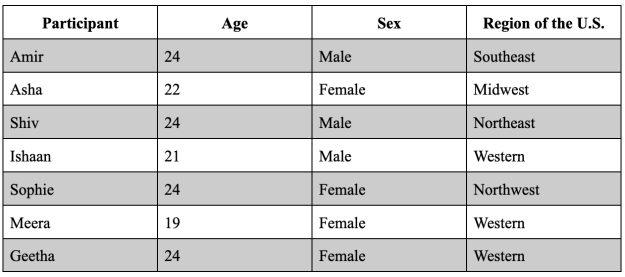
Additional descriptive data about participants is provided in the short narratives below:
Amir lives in the Southeast region of the United States He is planning to attend graduate school to obtain his Masters of Business Administration degree and currently works at a non-profit that focuses on increasing access to education. He reported that his mother immigrated from Western India and his father immigrated from Southern India. Amir described his family as being “Kutchi1” and practicing Islam. Amir disclosed that his parents initially arrived in the
1 The Kutch people are traditionally from the Kutch district of the Indian state of Gujarat, located in the northwest part of India and are defined by their own specific cultural values, traditions, and dialects (Kutchi).
Northeast region of the United States before settling down in the Southeast region of the United States.
Asha lives in the Midwest region of the United States. She recently obtained her undergraduate degree in psychology and is looking for a job within that field while applying to graduate school. She reported that both of her parents immigrated from Western India and ascribed to Hinduism. Asha described that upon immigrating, her parents originally settled down in the Eastern region of the United States and moved to the Midwest when Asha was a few years old. Asha currently lives in the same region she was raised in. Of note, during Asha’s late teen years, she was diagnosed with a physical health condition that caused her to stay in the hospital for an extended period of time. Asha remembers this time as being “touch and go” and reported that she and her parents wondered whether she would recover. She shared that she is now recovered and healthy but her medical condition influenced her relationship with her parents as they became more involved and hands-on in her life. This change in her parents’ parenting approach caused additional conflicts due to Asha wanting independence and autonomy to make her own decisions but feeling unable to.
Shiv lives in the Northeast region of the United States and is currently attending graduate school to obtain his Masters in Clinical Psychology. He mentioned that both of his parents immigrated from Western India in the late 1980s and ascribed to Hinduism. Shiv further shared that his parents originally settled down in the Midwest region of the United States and still currently reside there.
Ishaan lives in the Western region of the United States and graduated from college in 2022. Ishaan is currently applying to medical school and works at a crisis mental health line. He reported that his mother immigrated from Northern India and ascribed to Christianity and his father immigrated from Southern India and ascribed to Hinduism. He shared that he was exposed to both religions and provided the opportunity to choose the religion that aligned with his values. Ishaan disclosed that his father originally immigrated to the Southern region of the United States for school before settling down in the Western region of the United States where both of his parents currently live.
Sophie lives in the Pacific Northwest region of the United States and she currently works as a laboratory technician while attending graduate school for her masters degree in public health. Sophie is also in the process of applying to medical school. She reported that both of her parents immigrated from Southern India. Sophie disclosed that her parents originally immigrated to the Western region of the United States and still reside there. Of note, Sophie’s oldest sister passed away when Sophie was young. Additionally, Sophie’s father being a Christian Pastor was significant in her upbringing as this religious identity was used to inform the main parenting approach within her household. She states that religious expectations of respect, relationships, and emotional expression were heavily influenced by what was “allowed” to be said. She further stated that because she was the daughter of a religious leader in her community, she always had to be “proper” in front of folks in her community as she was representing her family and namely her father. She talked about how these expectations added to her limited emotional expressivity with her parents.
Meera lives in the Western region of the United States and is currently obtaining a dual undergraduate degree in biology and chemistry and hopes to go to medical school in the future. Meera reports that both of her parents are from Southern India and they ascribe to Hinduism. She disclosed that her mother originally immigrated to the Northeast region of the United States for medical school and her father originally immigrated to the Southern region of the United States for his graduate degree. Meera stated that her parents still reside in the Southern United States.
Geetha lives in the Western region of the United States and just graduated with her Masters in Clinical Psychology. She is now looking for a full time job within the field of Clinical Psychology. Geetha reports that her parents immigrated from Southern India to the Southern region of the United States and they ascribe to Hinduism. They eventually moved to the Western region of the United States where Geetha and her siblings were born and raised. Geetha currently lives with her parents. Geetha herself stated that she does not ascribe to Hinduism due to not feeling aligned with the principles of the religion regarding gendered expectations.
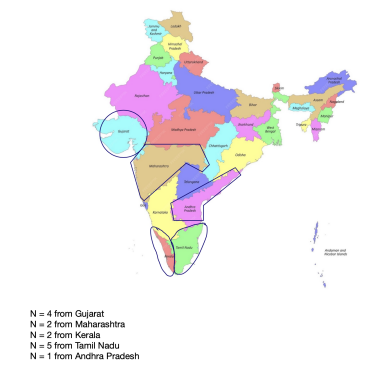
Some commonalities of the group include: most participants were raised either fully or in part with Hindu beliefs, cultural values, and traditions with the exception of 2 participants who had no exposure to Hinduism in their upbringing. Three participants indicated having at least one parent originating from the Western region of India and four participants indicated that at least one of their parents originated from Southern India. Most participants identified as “Indian-American” with the exception of two participants stating they identify as South Asian and American-Indian respectively. Four of the seven participants work within the mental health field or are in the process of obtaining a graduate level mental health degree (licensed marriage and family therapist and masters in clinical psychology). All participants have either completed their undergraduate degree and are in the process of attaining a graduate level degree or will be doing so in the next few years. Participants indicate the high educational expectations of many of their parents to be the reason for their educational attainment. Lastly, most participants’ parents accurately represented the states where most Indian immigrants who come to the United States immigrate from. These states include and are not limited to Andhra Pradesh, Tamil Nadu, and Gujarat (Hoffman and Batalova, 2022).
Please refer to Figure 1 for an understanding of where participants’ parents originated from in India.
Themes
There were 4 themes and 6 subthemes that emerged from participant narratives. Themes that arose from the thematic analysis procedure are listed in Table 2:
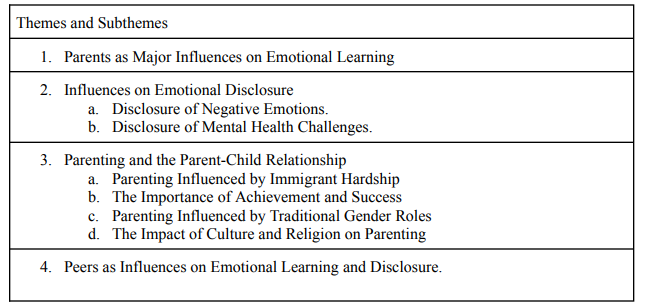
Participants’ narratives contained rich, overarching, and complex stories about their parents’ immigrant experiences and their experiences as children of immigrants, and there was a wealth of data gathered that exceeds the scope of this study. Emergent themes pertain to the research aims and reveal how participants describe learning about emotional expression and factors that influenced their expressivity and regulatory capacities in childhood and now. Results are organized sequentially so that themes and subthemes presented earlier provide context for themes and subthemes discussed later in the results section.
Parents as Major Influences on Emotional Learning. Participants described where and how they learned to express emotions and how that has influenced their emotional expression as adults. Parents and family members served as the primary channel through which participants learned about and received feedback regarding their emotional experiences during childhood. However, participants simultaneously spoke about the role of the surrounding immigrant community in which they were raised as reinforcing values and attitudes of their nuclear family. Most participants described a lack of explicit teaching around processing or expressing emotions from their parents. Rather, as children, they expressed emotions in whatever way felt comfortable to them and learned through verbal and non-verbal cues whether this approach was acceptable in their families and communities. Participants share:
“I don’t think in my household I was ever taught how to deal with emotions. It was more so like ‘oh, you’re angry? Have a tantrum. Oh, you’re sad? Cry. Oh, you’re happy? Run around kind of thing.’ It was like do what instinctually impulsively feels correct to do. No one [expletive] showed me how to express emotions. So I didn’t even know that was something to know, right? And I think that’s like the hardest thing where you’re like, I don’t know what I don’t know” (Amir).”
“They [My parents] don’t really understand the importance of engaging in discussion with your child that’s going through an emotional episode, rather than just telling them to go to their room or punishing them in a way which makes them less inclined to open up about their emotions straightaway” (Ishaan).
“But we weren’t really that family to have those conversations about, like, oh, I’m feeling this way, like, and then, I don’t know, it was it was never that like, it was never like, clearly communicated to like what I’m supposed to do with my emotions” (Geetha).
In interviewing these participants, I was able to notice that Amir’s recollection and way of sharing this information seemed formulaic in how he listed various experiences and the way he perceived acceptable emotional expression. He, Ishaan, and Geetha described feelings of having emotions but lacking guidance in how to be productive in expressing or processing them. They shared that they felt able to express their emotions but that their parents would not necessarily help them understand and navigate their experiences. When Geetha shared, her emotional expression mirrored that there is no place for her to express her emotions, which is what she experienced with her own parents: her affect was very flat and she appeared helpless when sharing and shrugged when sharing the quote above.
Participants also reported that their parents would not check in or talk to them after an emotional situation but rather that there was an avoidance in discussing these negative emotions. While some participants were provided the space to express and understand their emotions, most participants were given the message that negative emotions were meant to be taken care of individually. Parents exhibited more of a solutions-focused approach in their parenting style as opposed to processing and staying in the emotion. Participants described wanting their parents to talk to them about the emotions they were experiencing but often felt that there was limited permission to do so. When disclosing their experiences, participants often sighed or shook their head as a way of sharing their discontent about their past experiences.
Participants described difficulty in sharing emotions, especially negative ones, with their parents due to fear of being a burden or experiencing judgment. They shared that the unsaid expectation within their households was to push these emotions away. Participants also indicated that for all non-positive emotions, it was best to hide, internalize, or privately express their emotions due to fear of being called “dramatic” or “silly” for expressing their emotions. Participants share:
Ishaan shared:
“Because I think, okay, you know, these aren’t really things my parents are willing to work out with me. If I’m angry, they’re not going to come sit and talk with me. They’re just kind of like, go to your room and just sit there until you calm down or figure it out. You know, it’s not something that they’re, they’re willing to figure out…[like] okay, what’s causing this? What’s the root of anger? What’s the route of the sadness or frustration? Let’s very logically think about, oh, just go calm down, you’re not thinking straight, because you’re emotional, you know, kind of thing. So I think that’s part of the reason is just that it was not received well. And again, I think that’s something that even they probably face[d] when they were younger.”
Sophie shared:
“So I constantly put myself in that role to where I was like, okay, don’t cry, don’t show emotion, don’t do all this because it just might be inconvenient to other people. Like just go with it, like you can suck it up and just deal with it. My dad used to have a saying a lot and he would say to us, often, he would say life’s tough suck it up. And he would say that often I you know, kind of meant it for the most part in a joking way but there was always like truth to i-, not truth to it, but it was always like, he meant truth to it, like life is tough get get over it. So, I kind of like also took that like, okay, you know what? Even though I’m sad or even though I’m like, upset just like, just get over it.”
These participants share experiences of not being given the emotional support that they were yearning for. Instead the expectation was often to push it to the side or not talk about it.
Depending on the emotion, expression of emotion had to be done in a “digestible” way as to “not make waves” or “bring down the mood.” Participants described the expectation of a lighthearted nature when discussing more serious matters as to not make the environment uncomfortable. Many participants experienced dysregulation, or difficulty controlling emotions and how they acted on those emotions, throughout their childhood. They reported that their parents’ did not take their negative emotions seriously or that the severity of the associated experience was dismissed.
Parental feedback and emotional modeling played a significant role in how participants learned what emotions were acceptable to express and which emotions should be restricted. Participants stated that their parents would express their own negative emotions through non-verbal behavior such as giving them or other family members the “silent treatment,” and “throwing things” to express frustration, but items were never thrown at people. Participants reported that their parents would only verbally express “positive or happy emotions.” Participants attributed the hardships associated with being immigrants in the United States as a reason that their parents skewed towards expressing and valuing the expression of positive emotions over appreciating or expressing negative emotions. According to participants, this was one way that their parents had learned to cope with the challenges they encountered in being immigrants, and they extolled positivity as being a factor in achieving their goals. Consequently, less importance was placed on expressing a range of emotions. Through reinforcement from their nuclear and extended families and larger South Asian communities they learned that expressing “negative emotions” such as anger, frustration or sadness was unacceptable through both verbal and non-verbal behaviors.
Influences on Emotional Disclosure. Emotional disclosure is the ability for individuals to share or disclose emotional experiences with others. While there are many influences on emotional disclosure, this theme dives into how participants understood appropriate emotional disclosure and how that ultimately led to their emotional expressivity and regulatory capacities. Participants indicated three main influences on their emotional disclosure: parents, peers, and mental health. In this theme, we will primarily focus on parents.
Subtheme: Disclosure of Negative Emotions. Participants found parents to be the most influential factor on their emotional disclosure. Participants were divided in their experiences with their parents regarding emotional disclosure but many participants shared similar experiences of being able to only disclose positive or optimistic emotions both with their parents and with the larger Asian-Indian community.
Only one participant, Shiv, had a contrasting report to the majority of participants and experienced comfort in expressing a range of emotions with his parents. He stated that his parents were his safe space and that due to particularly difficult encounters related to bullying by peers when he was in middle and high school. He shared:
“And I think, you know, but that’s the thing, I did feel like I had supportive parents, and I did feel like I could talk about them with anything. I really really did trust them. My mom and dad were very supportive.” (Shiv)
Shiv shared how his experience of being bullied allowed him to cultivate a stronger relationship with his parents as he was “forced to share what was going on with my parents.” Shiv stated that his parents responded to his disclosure positively and consoled him. He further stated that his parents helped him find solutions to peer related issues and reassured him that he would be okay. He continued to share that regardless of if he was experiencing hardship or positive moments, he could discuss it with his parents in a way of seeking advice and gaining validation. In contrast to Shiv’s experiences, other participants share:
“I can express all my emotions with the exception of negative emotions naturally” (Asha). Asha shared that disclosure of negative emotions was uncomfortable due to her parents’ response to these emotions. She experienced a tendency to share only positive emotions.
“Obviously, like, you know, the easy answer is just like a lot of the optimistic emotions, like I was pretty open about excitement, happiness, joy, things like that, you know, being, laughing and things like that” (Ishaan).
“And a lot of the emotion that I felt comfortable expressing was like moments of happiness or like good things, you know?” (Sophie).
“Um, and then any, like, positive emotions, though like, I would tell my parents, like if I got a good grade on something, or like, obviously, like college decisions and stuff like if I got into solike a really good school or something like I would tell my parents immediately any good news” (Meera).
“I only felt comfortable expressing happiness” (Geetha).
It is important to note that multiple participants described that their relationships have changed with their parents and due to age and academic accomplishments, they now feel more comfortable disclosing a range of emotions and being more open with them. Participants have alluded that over time parents have become more understanding of their children’s needs and are more influenced by their host culture (the United States) where it appears that expressing a range of emotions is more acceptable.
Though participants found it difficult to name the exact ways they were able to regulate their emotions throughout their childhood and young adulthood, many of them described using self-comfort and self-reliance as a way to process and understand what they were feeling. This encompassed keeping emotions to oneself, not sharing it with family, and processing it in one’s own mind. Others had difficulty managing their emotions and experienced anxiety, depression, and other mental health related symptoms. Participants share their experiences with anxiety below:
“I would- I tend to bottle it in until like, I couldn’t hold it in anymore and then I would just lash out so to speak or like, just be really like, down. I think like that also transpired a lot into my adulthood and then I’d become extremely, like, anxious. I would have several like panic attacks, because I wasn’t able to just regulate, like, how I was feeling and my emotion” (Sophie)
“Myself, dealing with anxiety and other thoughts in my head that are very distressing to me…I know how it can affect people…I had a tough time properly regulating my emotions without it being made a joke” (Ishaan)
Of note, multiple participants described their approach to emotional expression as resulting in “withholding.” Ishaan shares that this approach developed not only based on family values but also the outer community with which his family engaged socially:
“But yeah, so I think a product of both it’s it’s the family, you know, not engaging with that the way that I was raised, but also my community outside of that socially, academically, is just, I became more, you know, with- withholding, in the way that I share and express emotions.
” Subtheme: Disclosure of Mental Health Challenges. All participants described a change in the way they expressed emotions as children compared to now. They share that throughout their life they have had corrective experiences through engaging in mental health services and forming strong peer relationships in their adulthood. Yet, multiple participants describe a difficult relationship with mental health challenges earlier on in their lives due to the stigma and beliefs surrounding conversations about difficulties with mental health that was held both at home and within their broader community. When asked to expand on their experiences, five of the seven participants discussed the impact of mental health on their relationship with their parents and larger Indian community. Participants described how mental health within their families and their communities is heavily stigmatized and conversations around seeking help for mental illness are hushed. Ishaan shares:
“I think something that I think of is like, and again, this goes to mental health. When I think about emotion, when I think about mental health, I just think of the word stigma, because it’s just not something that we ever talk about.”
Participants share the invalidation of mental health services and illnesses they experience. Participants who chose a career within the mental health field experienced their parents as being slightly more comfortable with them partaking in therapeutic services, but were instructed to refrain from discussing engagement in these services with those outside of the home.
Related to the experience of needing to hide or limit their expression of negative emotions, multiple participants shared their own struggles with mental health and the difficulty to disclose and express their low mood or sadness with their parents. Upon entering college and having the independence to seek out mental health services, participants described being fearful of sharing a “depression diagnosis” or any diagnosis with their parents and often struggled quietly. Other participants describe having a sibling who experienced mental health crises throughout their lives and how their parents’ secrecy about their sibling’s mental health difficulties affected their perception of what was okay, what was not okay, and what was to be hidden from the larger community or extended family.
Parenting and the Parent-Child Relationship. Parenting styles and approaches were a significant contributor to how participants described their experience of expressing and understanding emotions during childhood. Parenting style was found to be heavily influenced by immigrant hardships and how their parents, or the participants’ grandparents, parented them. Two participants reported that their parents assumed traditional gendered parenting roles. They described their mothers as soft, emotionally supportive, and more involved in their upbringing while fathers were described as strict, the breadwinner, and work-focused. Participants shared:
“So I remember as, like, when I was really little, my dad was always on business trips and stuff. We didn’t get to see him as much. So it was like mainly my mom who we’d like rely on like for emotional support and like all that” (Asha).
Meera experienced a completely different parental dynamic in which her father was her primary support system and she described a strained relationship with her mother because her mother set unattainable expectations for Meera. She shared:
“I love her. She’s great. But just the way that she treated me as a child looking back, I’m like, oh, no. Definitely my mom was very, very- growing up my mom was very harsh on me like, criticism wise in regards to like everything. My parents were both put, like a lot of pressure on me and that kind of caused me to put a lot of pressure on myself. And so, my dad has seen how my mom has treated me and he’s, like, defended me and he’s tried to get her to lay off but she always like push away and be like you’re not involved in this. My dad is my best friend” (Meera)
Collectivistic values including appearances of cohesion, expectation to keep the peace, abiding to parental rules without resistance, and being viewed as an extension of one’s parents were prominent in participant interviews. Sophie shares:
“And so my mom doesn’t view my brother and I, and for some reason, I think, mostly just me, as an individual, but more as extensions of herself.”
This was a common theme that other participants referred to when describing their parents’ parenting approach and style. Additionally, a few participants discussed the expectation for the nuclear family to appear as a united front, especially to community members and those outside the family. Asha shares:
“But it’s like, if anything big happens, like, if anyone’s fighting, like if my mom and dad are fighting or something or like if I’m feeling something about them… It’s like, I shouldn’t necessarily talk about that with anyone else.”
Multiple participants described certain parenting approaches such as physical discipline, limited warmth and empathy, and strict expectations to succeed as expectations that their grandparents had for their parents. Participants understood this as a trickle-down effect in how they were parented. Participants share:
“and it’s, I think that was the extent of the way that I was raised. And I’m not blaming my parents for that, because they were raised that way, too. It’s a generational thing that we need to be aware of, in order for us to change” (Ishaan)
“I think as the time progressed, though, my dad definitely like learned a lot from his parenting style. He learned his parenting style from his father because it’s the exact same way” (Sophie)
Participants described their parents as being unavailable to have emotional conversations which they linked to the hardships of immigration and understood as opposed to a lack of emotions.
Participants described being the recipients of a range of parenting styles. A few participants described being parented through a means of physical discipline which instilled fear and the expectation to abide. Participants shared:
“And I think it was the physical discipline and to an extent, like the shouting, and my parents getting mad at me. And it made me instill this, almost kind of driven by fear a little bit, I think, is a lot what a lot of people deal with” (Ishaan)
“And so again, my dad had a very different approach to raising us and he would, like, my dad was more into like spanking us, and like, you know, more physical punishment” (Sophie)
Other parenting styles included parents being warm and supportive. Asha spoke to how “most of the things that we hear about Indian parents are just like strict, authoritarian-ness.” She goes on to describe that her parents were the opposite of this stereotype and were often easygoing, warm, caring, and understanding. She shared:
“Very supportive. Very warm. Yeah…Um, but in, in general, I’ve never like, growing up, I never felt like oh, I, I shouldn’t tell my mom or dad about this thing that happened, you know, like, I’d always go to them for advice. Or like, I’ve always, like, I’ll say, like, Oh, I really want to, you know, do this. And my parents would be like, okay, like, yeah, like, absolutely try it, do that. If they really hated it, they’d be like, are you sure?”
She described her parent’s parenting style as supportive while setting limits and enforcing rules that are often seen in authoritative parenting styles. Amir, Shiv, Meera, and Geetha also describe similar experiences with their parents. Participants share:
“Yeah, I mean, the support was unquestionably there. Like it was always there” (Amir)
“And I think, you know, but that’s the thing, I did feel like I had supportive parents, and I did feel like I could talk about them with anything. I really really did trust them. My mom and dad were very supportive” (Shiv)
“So like, I knew my dad was supportive from like, the get go, so I knew he was like, supportive, and like, he’s very much the kind of parent who’s like, I just want you to be happy. And he’s like, I just want yeah- he’s always been like, you just, you should just do whatever makes you happy at the end of the day” (Meera)
“In terms of parenting, I would say that, you know, they were overall like, really supportive and like lenient” (Geetha)
Some participants experienced their parents as being involved and sometimes overinvolved in multiple facets of their lives. Participants describe this involvement below:
“We care about you as our kid and as our only kid, so we need you to stay in the house. And like if you leave the house, like, text us every hour, make sure you know we know where you are” (Amir)
“But like, my dad especially is like, I don’t know – I feel like he has trouble letting go, you know? Like he’s always asking, like, like, he’s always giving me advice that I don’t want. Which sounds bad but I don’t need his advice on every little thing, you know?” (Asha)
“Then, yeah, but I mean, I think my mom was such, like, a prominent person in my life. And she’s like, she still is where she was just, like, very involved.”
These participants additionally shared parental involvement was at times overbearing and did not allow them the independence and autonomy to make their own decisions or mistakes. It is important to name the dichotomy in participant’s experiences as their parents’ overinvolvement was perceived as very supportive but they still were not able to express their negative emotions to them.
When asked to recall their parents’ parenting style, most participants described a change in how their parents parented them as children versus as adolescents and young adults. Some participants described their parents to have taken on a more involved approach through their childhood and adolescence but now experience their parents as more friendly and participants share feeling more comfortable to disclose to their parents and vice versa. It is worth noting that though participants experience their parents in a new way, they describe their parents as still being very involved in their lives. Asha shares:
“Like, even now it’s like, oh, did you send that email? And I’d be like, Yeah, but it’s like not- like, let me send my email. Like little little things like that, where it’s like, like, I just wished they could understand that I’m not like you know, the little sick 17 year old. Like, I’m 22. I’m a big girl. Now I can do these things by myself. Like, yeah, okay, then I’ll fail like it’s okay.
When Asha shared this experience she appeared to be frustrated with the lack of independence she has regarding making decisions for her life. Participants share that there are some relationship dynamics with their parents that have been maintained from their childhood into adulthood. While some of these dynamics are disappointing to participants they also indicate being appreciative of certain dynamics such as the support that they receive from their parents. They further share wanting to individuate and be autonomous from their parents but still are viewed by their parents as needing guidance.
Subtheme: Parenting Influenced by Immigrant Hardship. Participants provided a unique view of their perceptions of their parents’ immigration story. Participants disclosed their parents’ hardships and the purpose of their immigration to the United States of America. In talking about what brought their parents to this country, participants shared that “economic opportunity” (Amir), “job opportunities” (Asha), and “a better life and opportunities” (Shiv) were often what they were told when parents recalled their story.
Participants described the hardships that their parents experienced including isolation from family and friends from their country of origin and financial struggles. Multiple participants recalled their parents sharing the difficulties that economic hardship caused. For example, Geetha mentioned:
“…but for him, I would say like, he’s told me that the struggles are more like financial. And like, he was kind of just having to, like, make it on his own and survive on his own, without really any, like, parental financial support.”
This quote demonstrated the hardship that many immigrants face when coming to a new country. Participants further shared the resiliency, motivation, and work ethic their parents had in order to succeed in this country. Amir shared:
“…as an immigrant, you’re like, you, you do whatever it takes. You work as hard as humanly possible, you you you do anything that you can to make sure that you can accomplish your goals.”
This sentiment of incredible hardwork and dedication was shared amongst other participants in their view of their parents immigration story. Participants also provided insight on the impact that their determination made on what participants prioritize and find important. For example, Ishaan shared:
“…hearing about my parents’ story and their drive for success has really instilled those core values in me to focus on success and make my parents proud of me and just be really aspirational in what I can do.”
In conceptualizing and understanding their parents parenting style, participants described the concept of parental sacrifice. This was defined slightly differently by participants, but could be thought of as the sacrifice their parents made when immigrating to a new country. Participants described their parents’ heavy handedness, strictness, and involvement to be a product of this sacrifice. Participants share:
“Like I get it now. I understand a) what they gave up to get here and then trying to do the best they can. Like might have not been perfect. It might not have been… ideal, but it was was the best that they could do..” (Amir)
“And they didn’t have much, my dad, for example, came to Detroit with practically nothing, he worked in the back of restaurants, cleaning dishes to get by, worked in the library making like $4 an hour or something like that, to make ends meet. And so just hearing about his struggles to get to where he is today, and to raise us without having to worry about finances, or what you know, what we can pursue and really allowing us to flourish is something that means a lot to me, and really just my desire to reflect that, and give that back to him and make him feel comfortable and allow me to take care of him” (Ishaan)
While participants wished that certain things were different such as increased autonomy, more conversations regarding emotion, and different styles of discipline, there is a substantial understanding and respect in why their parents parented in the way they did. Participants were largely in agreement that because of parental sacrifice, parents parented on the basis of their children being successful.
Subtheme: The Importance of Achievement and Success. Influenced by parents’ immigration hardships, a common theme that arose for multiple participants was the importance of education and achievement. For some, their parents’ parenting style could not be uncoupled from the expectations of achievement and success. Education was often seen by immigrant parents as a way to escape hardships and further oneself in their career and ultimately lead to a successful life. Asha shares:
“[T]he vibe in our family is always like education is the most important, right? Like education is super important, that’s how you climb out of poverty, that’s how you, you know further yourself.”
Similar to Asha, Meera disclosed:
“They’re both like, ridiculously intelligent, my dad went to IIT in India, he went to IIT Madras, my mom went to like one of the top like post grad programs in India, she went to Columbia, she did her fellowship at Cleveland Clinic, like, both with my parents have very stacked resumes and are very intelligent people and very career driven. And that definitely put a lot of pressure on me growing up to achieve a lot academically, and to like, succeed academically, because I saw how much my parents had, like, you know, sacrificed.” (Meera)
Education and success was found to be a huge influence on the way most participants’ parents parented them. Many participants shared the pressure that they felt to succeed and how it led to high expectations that often did not feel attainable. Participants additionally described the stress they felt multiple times throughout their lives due to these expectations. Sophie shared an example of a conversation she might have with her parent:
“How was school? When are you going to start applying to med school? What med school are you planning on applying to? Like it’s like a checklist…they’re supportive of me going to get my master’s degree, but for them, it’s not a big deal. Their, it’s just their eyes are on med school. And yeah, they don’t care about – or they’re so fixated on med school and like and when I’m gonna get there and everything else, it’s like everything else is dismissed.”
In sharing this, Sophie looked down and appeared sad due to her current achievements not being celebrated or acknowledged. Her speech was slow as she listed off the rhetorical questions her parents repeatedly ask her in regards to medical school. Her mood appeared low as she stated that she would never be able to live up to her parents expectations. Similar to Sophie, Meera shared:
“We had to take the little multiplication tests, right? I remember I got an 89 on one of them. I got an 89 because I missed I think three, instead of two, of the questions. I was full out sobbing in class and I was like ‘my parents are gonna kill me.’ Like I literally thought if I showed my parents an 89, my mom’s gonna scream at me. End game I was like, done for. In third grade, like, be f****** for real.”
Meera was laughing when sharing this experience as a way to describe how unbelievably high and ridiculous of an expectation this was to put on a child. She goes on to say
“Like if she heard I got a 31 [percent] on my inorganic midterm….um yeah…”
Through Meera’s non-verbal cues of shaking her head, rolling her eyes, and looking down, it could be understood that she appeared defeated. She described feeling that her mom thinks of her as inadequate or less than due to her inability to live up to her parents’ academic standards.
Sophie and Meera both share emotional experiences they had throughout their childhood and the pressures they experienced.
Participants acknowledged the importance of education their parents instilled in them but shared the fear of failure that they often experienced and continue to experience. Values of achievement and success were so strongly passed down that participants internalized feelings of worry, fear, and inadequacy if they did not meet high expectations set for them. Most participants discussed the role that academics played in their upbringing. For example, Ishaan shares:
“So a lot of it, you know, especially in terms of school, because school is a huge thing for them. School is a predictor of success, which whether that’s the case or not, they- it’s kind of- there are certain routes that you are suggested to take, or you will face backlash, right? Going back to that statement, are you an engineer, a lawyer or doctor? So if I deviated and say, you know, say I wanted to be like an artist or something, or a musician, I don’t know fully well, if my parents would have supported me that pursuit. They, you know, they wouldn’t have like cut off communication or anything like that. But I don’t know if they would have been supportive of my goal if it hadn’t been, you know, I want to be a doctor. That’s something that I’m fortunate enough to, I want for myself, not just, you know, my parents are forcing me to do that. But I know that’s the case for a lot of people from South Asian descent..”
In Ishaan’s disclosure, he appeared to show empathy for others who have heard similar messages through the shaking of his head when describing the cultural expectations of achievement and success. He also appeared to be sympathetic towards individuals that did not fall into an “expected” career due to the backlash they might have experienced from their parents and community members. Similar to this participant, other participants described the value placed on education as a marker of success and discussed their parents’ lack of support if the profession was not accepted by the greater community. Participants shared in this feeling of rigidity that they experienced from their parents.
A few participants discussed the concept of model minority in regards to achievement and success. Participants share:
“That was like Oh, this is like the model minority. Like this is how it should be. You are expected to work and live up to that model minority label” (Amir).
Because like, and I think maybe it’s like a model minority thing, maybe it’s just because like, you feel like you have to succeed and you have to do everything right and, you know, you can’t show weakness” (Shiv).
When sharing these expectations of being the model minority both participants appeared broad in their affect and shared feeling emotionally laden. They describe the external pressure they felt regarding achievement and disclosed how this stereotype further perpetuated a narrative that was harmful to their emotional well-being.
Many participants indicated that disclosure and expression of positive educational accomplishments would often lead to a closer relationship with their parents. This led many participants to lean on this aspect of emotional disclosure and expression in order to form bonds and gain validation from their parents. Participants held the ability to appreciate and be kind towards their parents’ parenting approaches due to an understanding of how their parents hardships impacted their parenting styles. Yet, participants described feeling emotionally distant from their parents and shared sentiments of wanting to individuate and be more autonomous as emerging adults. Participants express feelings of their development being stunted due to not having the chance to make decisions independently and yearned to be able to grow and learn from their own failures and successes.
Subtheme: The Impact of Culture and Religion on Parenting. In their interviews, participants shined a light on how culture, religion, and tradition played key roles in their upbringing and how it influenced their values. Participants shared being exposed to Hindu celebrations, learning about their heritage and feeling connected to culture through food and language:
“But we had like, like Indian parties. Like we had a group of Indian friends all like Maharashtrian and stuff. So we’d always celebrate Diwali with them growing up” (Asha)
“Or if it’s like, you know, like going on Sundays to I think we called it Svadhyaya2 which is basically like, like, it’s like, not church, but like, you go there and you do prayers. And you go and you like, do prayers, like say all your prayers and you know, they teach you like stuff about religion like Mahabarat3 and you know all that” (Shiv)
“I think it impacts a few things, I guess in terms of like, language, like, primarily, the language spoken at home or like to my other family members is like Malayalam. And even like my cousins, even though we’re fluent in English and in Malayalam, we were all born and raised here, we tend to, like, gravitate towards speaking Malayalam to each other, even though like we can speak English to each other.” (Sophie)
Participants described the beauty of being exposed to their culture and religion and described a sense of community that they felt. They discussed how they were exposed to culture through gatherings outside of the home as opposed to traditionally religious gatherings (e.g. temple).They further described a sense of belongingness and ability to bond with others who have had similar “life experiences, barriers, and issues experienced.”
Another concept that arose for most participants was the role that collectivistic values played in their life. A few participants describe the influence of growing up in joint family households:
“I grew up with my grandma and grandpa. I lived in a joint household, that was definitely something that I was like, oh, ashamed, or like really felt weird about because it just didn’t feel common. But now that you think about it in hindsight, it’s like, that’s, there’s so much importance to knowing your family’s roots and being able to like, understand a completely different perspective” (Shiv)
“And especially that ties back to I think South Asian familial values of, you know, why does my grandma live with us? Is because we keep each other close. And we want to be with our parents and treat them the way they treated us when you’re younger and take care of them” (Ishaan)
Participants also described the intricacies of balancing their bicultural identities through both embracing their heritage culture and their American culture. Some participants described a
2Self-study and recitation of the Vedas and other sacred texts 3 Mahabarat translates to Great Barat (India) and is a story of the great descendents of Barat (India).
difficulty in balancing individualistic values that they were taught outside of the home with the collectivistic values that were expected to be followed within the home. Shiv shares similar sentiments to other participants:
“I think being an American means embracing, you know, your Indian culture and the immigrant experience within your family, and also trying to balance the feelings of being an American growing up within a western society and kind of doing the somersault not somersault this walking the fine line between growing up in an individualist – in a collectivist – individualist culture outside of your home and a collectivist culture inside your home.”
Participants depict the difficulty of individualizing from their parents due to fear of being reprimanded or being a cultural outcast. They share:
“you know, when you grow up within a culture that kind of encourages, like respecting your elders, or, you know, living within a close knit community. And maybe doesn’t value as much being assertive, being outspoken, or being you know, kind of putting your needs below the needs of your community. And also, at the same time you grow up in a culture that tells you to focus on yourself. And so it’s this balance between, you know, collectivism and individualism” (Shiv)
“I feel like our culture emphasizes a lot that like, you know, the whole family values and like if you choose yourself that means you’re betraying your family, but I think it’s okay to to disappoint other people sometimes and you know, choose things just for yourself, even if it goes against, you know, everyone in your family or your culture” (Geetha)
Participants shared an array of experiences regarding how culture, religion, and tradition impacted them and their values. It is imperative to mention that though multiple participants describe the nuances in balancing cultural expectations, many participants share wanting to maintain those collectivistic values they learned from their parents as a way of respect. Participants disclose:
“My ultimate goal is to retire my parents and like buy them a house” (Amir)
“My parents have sacrificed so much so my ultimate goal is to be successful so I can take care of them when they are older” (Ishaan)
“I also was like, have always been like a worrier from a very young age. Like I was always from like childhood worried about, like, my parents being older and like I needed to make money, I need to take care of them” (Meera)
Female participants experienced an overwhelming pressure surrounding the topic of marriage and marital expectations. Female participants described the main topics of conversations being around societal and cultural expectations put on them. For example, Geetha shared:
“And I feel like the way that my parents say it is like, oh, we’re not forcing you to get married, but this is like what you have to do in our society, like, we’re not forcing you, it’s like, our culture, the cultural values are kind of putting, putting us in that position where we have to, you know, tell you the right, we have to guide you in the right direction. Meanwhile, like, my oldest brother, who’s right now like, 31, he’s not married yet.”
Geetha continues to say that these expectations, cultural and gender norms that have been put on her have strained her emotional expression with her parents. Sophie and Meera share similar experiences of feeling the pressure to conform to cultural expectations of marriage. They further describe difficulty in expressing emotions that do not align with these expectations for fear of being reprimanded.
Participants shined a light on how the influence of their cultural background, regardless of their relationship with their parents, impacted how they perceive the world and the values that they obtained from being exposed to their heritage.
Peers as Influences on Emotional Learning and Disclosure. Peers also played a role, albeit secondary to parents, in determining the content of emotional disclosure and expression. It is important to note that peer influences were discussed significantly less than participants’ parents regarding emotional expression.
For most participants, peers primarily acted as a corrective experience of emotional disclosure. Participants who experienced difficulty disclosing emotions to parents often relied on peers as their support system. Meera shared:
“So it’s like I very much have leaned on like close friendships for support. And I very much did in high school for like, any semblance of like emotional expression, like going to my friends. They accepted me and never made me feel weird for having feelings or emotions or whatever”
Other participants shared similar sentiments and stated that they gravitated towards their friends especially when sharing content they knew their parents would not approve of. Participants shared feelings of connection and closeness with peers that identified as culturally similar to them. This allowed them to more easily disclose without the need to “explain” their emotions or relationships with parents.
A few participants shared that their experience of being excluded or different influenced who they disclosed to and who they befriended later in life. Sophie and Meera share:
“And I think that looked, and then, culturally, I, I’ve always- I think besides in like elementary school, when I was genuinely the only Indian person at my school, I, I can’t, I can’t like fully remember what that- I mean I do remember what that experience was like, just mostly because like, I was the only brown girl and like a lot of people, you know, talked about, like, my hair, or like, you know, the hair on my arms, and my legs and my unibrow and like, all those things, as kids.
“It very much put me in this position of like, I felt like I was like too white for the Indian people and too Indian for white people.
In the quotes above, participants share how their culture impacted where they felt accepted and where they faced a lack of acceptance. This lack of acceptance heavily influenced participants to seek out connections with those culturally similar to them when they reached adulthood. It was shared that cultural similarities allowed participants to disclose their emotions without having to explain where they were coming from. This often created comfort and belongingness. Participants share:
“Yeah, so one person for me was my roommate, my best friend in college, he is, his parents are from Bangladesh. Similar, you know, cultural values and very familiar, familial values. I think, just him understanding the struggle with that respect and him also recognizing, there was a lot of a lot of empathy, having been in that position too, because, you know, our own struggles, he was dealing with other mental health struggles, I was dealing with those, knowing each other’s situations. Being able to confide in each other after knowing each other for so long, I’m glad that I had somebody that you know, and they knew what it was like to be able to experience that and not really have your parents to talk to you. Because his parents were kind of the same way. It’s not really something you talk about. But it’s something that he recognized is very important.” (Ishaan)
“And I didn’t really think about it. And then I, when I came to middle school, I was just like with a bunch of different backgrounds, and the high school and middle school that I went to was, there was a lot of like Indian people there and there was a lot of other people from other ethnicities as well. And so I think, in many ways, I felt so much more in tune and welcome to embrace my culture because I, you know, would go to school and like, everyone is bringing, like the chapathi and like, you know, like lentils to school like daal to school, like, their ethnic foods, or everyone’s eating food from their own culture. And so it was definitely more inclusive.” (Sophie)
“But I’m an intern at the Cross Cultural Center on campus and so I very much sought out community in space of other students of color, even though I go to like, a very, pretty diverse university. And that’s part of my reason for choosing to go here is because like, I just didn’t want to be in that predominantly white environment anymore because I just knew, like, I think being in an environment where I had to hide my identity so much, it made me realize that like, I need to be somewhere where I do not have to hide my identity.” (Meera)
“Yeah, um, I think I definitely, in general, just lean more towards being friends with other like people of color in general. Not particularly just like Indian American people, but anyone. I do have, like quite a few Indian American friends, which has helped me in a lot of ways.” (Geetha)
The quotes above describe this feeling of inclusion and acceptance which often allowed participants to feel comfortable in disclosing their emotions with their peers. Participants shared that friends acted as an area of comfort and unconditional support.
Though most participants described their peers as corrective emotional experiences, a few participants described pivotal experiences throughout their childhood that caused them to restrict their emotional expression around peers. Shiv shares how his experience of bullying affected his ability to make friends later in life. He mentioned:
“I also do think, just like feeling that I also did, like, feel isolated and I also did feel like you know, like, I also went like, was bullied quite a bit too, so that definitely, like hurt me. During high school, especially, I remember like, I cried, like, one time in the lo-, in like, the boys locker room one time and this one guy, like said, I was sensitive. And so like that also, like made me feel like oh, I didn’t like, wasn’t able to like talk about some of these issues and, and be vulnerable. So I think also like the bullying and also just like these ideas around like masculinity definitely played a role.”
He continues on to say:
“Yeah. You know, I think it definitely, like the bullying did affect me and like, I think, full disclosure, I am still, I still, I still like do therapy over some of this stuff because it did affect my ability to form close relationships with people. I have good, I have friends I could reach out to, like don’t get me wrong. But I would say definitely influenced my ability to form close relationships, and really form these strong bonds.”
Ishaan also disclosed:
“As a youth in high school, I was, you know, I kind of just made light of mental health and emotions and all of that kind of thing. I went to an all boys school, so that’s a whole other, you know, societal influence, that emotions are not really meant to be discussed among men or, guys. That’s not something that was emphasized.”
Both Shiv and Ishaan share how these pivotal experiences throughout their childhood have caused them to further learn that males were supposed to express certain emotions and bury others.
Geetha also shared an experience of disclosure with a peer regarding her mental health. She describes how her peer’s frustration of her mental health disclosure changed her perspective on what she could or could not share:
“So I was kind of like, okay, like, I don’t think anyone wants to hear this right now. But I had no really like, no support system at that time and didn’t really feel comfortable, like reaching out to people. That made me feel really isolated so I learned to keep to myself.”
The idea of gender norms and expectations was prevalent throughout the interviews and influenced emotional disclosure, expression, and regulation of the participants. Male identifying participants discussed the impact of masculinity on their emotional expression both at home and at school. Participants shared:
“Gender identity, gender expression take place, like whether, you know, in the case of boys, it’s more like masculine identity and for girls, it’s obviously like, acting in a more feminine way or, you know, that socialization. And so that definitely, like, kind of gave off the impression that like, being dominant, being aggressive or maybe like even using anger was an acceptable emotion. And so like that also, like made me feel like oh, I didn’t like, wasn’t able to like talk about some of these issues and, and be vulnerable. So I think also like the bullying and also just like these ideas around like masculinity definitely played a role” (Shiv)
“As a youth in high school, I was, you know, I kind of just made light of mental health and emotions and all of that kind of thing. I went to an all boys school, so that’s a whole other, you know, societal influence, that emotions are not really meant to be discussed among men or, guys. That’s not something that was emphasized. You know, it’s like the typical, like, teenage boy kind of interaction that you’d expect. The very stereotypical thing like, you know, you’re always cracking jokes” (Ishaan).
The idea of hypermasculinity, expectation of dominance, and emotional withholding that male participants experienced demonstrated lasting effects on the way they express emotions today. Male participants described how peer relationships impacted their perception of acceptable emotional expression and disclosures.
Some participants shared that college provided an opportunity to relate to others that have had similar experiences with emotional expression and allowed them to slowly open up about positive, negative, and vulnerable emotions. A few participants stated that the way they expressed emotions growing up was not the most “effective or productive” and that with time they learned there are “better ways to express emotions.” Participants shared that they wish they were provided the emotional vocabulary to express their emotions and were taught that “negative emotions” were okay. They share:
“Like, yeah, how do you like, I’ve come far enough to know that like, anger isn’t a bad emotion, right? It’s just an emotion. It’s how you express it that’s, you know, harmful or whatever. So you want to find a healthy way to do that. There can be a point where you feel that anger, but you don’t have to express it in a way that hurts others, but you still have that anger. Like having anger isn’t a bad thing, it’s just an emotion” (Asha).
Participants described wishing that they were taught how to express emotions from a young age as opposed to being told to “suck it up,” “move on,” or “think positively.”
While some participants experienced a journey of self-discovery that ultimately led to finding peers similar to them, others described the discomfort they had amongst peers and the hope for belongingness, inclusion, and a support system. Though emotional expression was not outwardly discussed when talking about peers, there was a theme of seeking comfort of confiding in peers.
Chapter 5: Discussion
Discussion of Themes:
This study sought to understand how second-generation Asian-Indian Americans learned about and expressed emotions in their childhood and adolescent developmental periods. Findings present how and from whom this population learned about emotional expression and factors that influenced their ability to regulate and express emotions. For the purposes of this discussion, it is constructed in two parts: the parent-child relationship, which was by and large the most significant experience that participants talked about, and the second is changes in development which was oftentimes influenced by peers as the participants became adults.
Parent-Child Relationship:
Parents and their immigration experiences contributed significantly to the way they approached parenting. When asked to describe how parents parented them throughout their childhood and adolescence, participants described a heavy handedness in how their parents interacted with them. Most participants described their parents through the lenses of traditional parenting roles viewing their mothers as more warm and supportive while their dads were described as distant or busy (Desjardins and Leadbeater, 2017). Parents immigration journeys and hardships endured appeared to be a significant factor on parenting approaches. Participants describe their parents having parented through the lens of their native culture while living in their host culture. Many participants’ parents experienced stressors such as financial difficulties, being away from their home, and not knowing anyone in their host culture. This contributed to all of the participants’ parents finding community through engaging with religious institutions, cultural happenings, visits to India, and gathering with other Asian-Indian immigrants as a way to stay connected to their roots (Inman et al., 2009; Shariff, 2009; Londhe, 2015). Participants emphasized that this was one of their parents main parenting styles that exposed them to values that were important to their parents.
Children of immigrants are tasked with managing two cultures and research shows that their parents immigration plays a significant role in how they perceive their own identities, how they are socialized, and how they balance culture and expectations (Dasgupta, 1998; Londhe, 2015). Evidenced by the disclosure of all participants, they describe the want to gain more autonomy but struggle with being able to attain it due to their parents parenting style that often focuses on a more collectivistic view of family. This attempt on part of both the participants and their parents to preserve certain parts of their heritage is greatly evident in this study.
Participants had significant insight on why their parents parented them in the way they did. Participants discussed how the hardships of their parents immigration journey has caused them to put pressure and stress on their children in order for them to be successful. Participants disclose how the expectations of achievement and success was a significant way their parents parented them. Participants further described that because they learned that their parents strongly valued academic success and achievement, they would disclose these successes to their parents as a way of bonding with them. They described that they felt that their parents did not value the discussion of general emotions but celebrating educational or career achievements was an area that parents expressed happiness.
In recalling the way their parent’s parented, participants disclosed that they were not outwardly taught how to express their emotions, but rather they were socialized to know which emotions were appropriate through their parents’ acceptance or rejection of expressed emotions. Participants described that their parents entertained positive emotional expression and often tolerated or were unsupportive of negative emotions. They further discussed how their parents socialized them to move forward from negative emotions and to think practically as opposed to sitting with and processing the emotions they were experiencing. There are multiple factors that contribute to this approach to parenting including immigration hardships and the collectivistic expectation of emotions. To further explain, research demonstrated that emotions that were thought to not contribute to the family’s overall wellbeing or did not serve a purpose of maintaining familial relationships were not easily accepted by parents. Due to this, parents often socialize their children to control their negative emotions or reprimanded them for outwardly displaying these emotions (McCord & Raval, 2016; Kitayama et al., 2006). Participants shared experiences in conjunction with the available research and disclosed that they were often met with parental frustration or a lack of acceptance when feeling sad, angry, mad, frustrated, etc. While participants described more comfort in expressing positive emotions due to their parents’ acceptance of these emotions, there is limited research on how parents respond to their child’s positive emotional disclosure. Parental emotional modeling plays a significant role in which emotions children feel comfortable expressing as this teaches them what is and is not okay. Participants described their parents as never complaining and moving through their difficulties as opposed to spending time with their emotions. Participants attributed this to the hardships of immigration and the fact that if their parents did focus on their emotions as opposed to continuing to move on, they might not have been as successful.
Though participants demonstrated an understanding of their parents’ parenting approach, they described how being invalidated when they were angry, frustrated, or sad led them to withhold their emotions and experience emotional dysregulation during moments of heightened emotion. Parental acceptance of emotional disclosure played a significant role in what participants felt comfortable sharing. They describe that their parent’s supportive or unsupportive responses to their emotional disclosure greatly impacted their comfort in expressing emotions. When met with punitive reactions from their parents, participants remembered responding through throwing tantrums or yelling back. Consistent with available research, punitive reactions from parents can be linked to inappropriate or out of proportion emotional regulation strategies during times of conflict. These instances can also lead to increased anxiety and depressive symptoms, difficulty managing emotions in emotionally-arousing situations due to limited practice in appropriately regulating one’s emotions and poor emotional awareness (McNeil and Zeman, 2020; Cabecinha-Alati et al., 2019; Morris et al., 2007, Eisenberg & Fabes, 1994; Eisenberg, Fabes, Carlo, & Karbon, 1992). Participants who grew up with parents that showed limited emotions had difficulties with expressing their emotions later in life. They also described internalizing their emotions or being unable to understand what emotions they were experiencing. Individuals that are raised in households with less emotional expressivity grow up finding it difficult to manage emotional distress (Teizer et al., 2014).
Multiple participants brought to the forefront how these emotional expressivity expectations created substantial distress and invalidation throughout their childhood and adolescent lives. They described how mental health was severely stigmatized within their communities and within their households causing mental health services to be utilized in secret. While these participants did not go in depth into the mental health stigma they experienced, they alluded to a lack of acceptance of help-seeking behavior and being seen as weak-minded. For many South Asian Americans they feel guilty to portray their parents in a negative light to clinicians which adds another layer of difficulty in accessing services (Sharma et al., 2023, Desjardins and Leadbeater, 2017; Jambunathan and Counselman, 2002). Participants described experiences of feeling misunderstood by their community especially if they had a mental health related diagnosis such as depression or anxiety. They spoke briefly of fear of ostracization due to their community having a limited understanding of mental health and their experiences are congruent to the available literature. Participants also described having corrective experiences with mental health through their peers and also through wanting to improve themselves and overcome stigma that they have been taught to associate with mental health. Going to college and experiencing the transition to adulthood has been a healing experience for most participants regarding their mental health growth.
Of note, female participants indicated that their parents parented them in accordance to their gender. It has been found that daughters of Asian-Indian immigrants are expected to continue cultural traditions, stay connected to their heritage, and shoulder the responsibility of what it means to be Indian (Jambunathan and Counselman, 2002; Khemmani et al., 1995; Cooper, 1991). Participants described an overwhelming sense of responsibility that did not necessarily align with their values. Female participants described their parents’ hopes that they would be married, have children, be a homemaker, etc as unspoken expectations that influenced the emotions they were “allowed” to have. The expectation to uphold tradition and culture that many of the female participants experienced also led to secrecy in many aspects of their life due to feelings of invalidation that they received from their parents. Secrecy included concepts such as dating and alcohol use where participants felt afraid of backlash from parents had they disclosed these parts of their life as this was a stark contrast from upholding cultural expectations. This also led to limited emotional disclosure of experiences and participants indicated having a hard time with dating and emotional flexibility with partners. G Further, there is hardly any research discussing the gender roles of sons and how boys are socialized regarding Indian culture. Though many of the concepts discussed within this article are still existent in the participant’s experience, it is important that there is continued and newer research that contributes to this topic.
Participants indicated that their relationship with their parents has changed over time yet they continue to experience a lack of autonomy and independence from their parents. On one hand they are seeing their parents as more supportive but on the other hand they still experience their parents as hand-holding them. Participants describe yearning to gain more independence in their young adulthood but feeling unable to do so due to feelings of having to oblige and listen to their parents. Current research shows that most parents view the age range of 18 – 23 years old as a time to facilitate independence for their children. They do this through providing emotional support while encouraging independence in decision making (Desjardins and Leadbeater, 2017; Jambunathan and Counselman, 2002). Contrary to what current research shows, participants in this study experience their parents differently and express feeling stifled in their development. Research demonstrates how parental psychological control in emerging adulthood and beyond can hinder independence and pose difficulty in identity development, expression, and general autonomy. This has not been studied with the Asian-Indian American population, yet, through participant disclosure many of them have discussed how they do not feel like they had the independence to make decisions that best suited them. Over time, participants learned that it is better to suppress their emotions and have grown increasingly reluctant to disclose or express what they feel.
Though participants described feeling that their parents’ expectations were overwhelming in certain situations, especially when comparing themselves to their White peers, they understood that their parents had sacrificed immensely to immigrate to a new country. When participants recalled their parents’ parenting style, the concept of parental sacrifice arose for many participants. They viewed their parents’ cultural ties, heavy-handedness, and strictness to be a result of everything they had to sacrifice to be “successful” in their immigration. Research does not discuss how children of immigrants’ views of their parenting styles change with time and this needs to be an area of continued research to better understand how participants now experience their parents and what values they continue to ascribe to and what values they no longer hold. Additionally, there needs to be increased research to understand how parenting styles affect the emotional outcomes of second generation Asian-Indian American individuals.
Changes in Development
Though discussed much less than parents, peers were identified as a significant determinant of the content of emotional disclosure and appropriate emotional expression. While this has been deemed to be typical through extant literature (Wylie et al., 2023; Main et al., 2019; Khaleque and Rohner, 2012; Chaparro and Grusec, 2015), peers played an influential role when participants reached adolescence and young adulthood. For most participants, interactions with peers served as a corrective experience from parental invalidation. Yet, for others, experiences of being rejected led to significant changes in emotional expression and disclosure.
Several research studies exist regarding how gender plays a role in emotional expression. Social construct theories exist that demonstrate how boys are often socialized to display emotions that are more aggressive while girls are socialized to be softer and quieter (Chaplin, 2015, Baron-Cohen, 2002; Zahn-Waxler et al., 2008). Male participants in this study recall that during their adolescence they were expected to not disclose emotions with the exception of anger or frustration. While on the other hand, most female participants remember the expectation of keeping their emotions in and having to be more positive. Participants remember feeling the need to suppress their emotions due to fear of invalidation from peers, which is a finding that is strongly supported in available research. Adolescents are more likely to suppress intense emotions, which is a form of emotional regulation in which the individual conceals their emotional expression (Wylie et al., 2023; Gross and Cassidy, 2019; Kashdan and Rottenberg, 2010). This was true for most participants who shared that when they experienced intense emotional reactions with peers, they would often suppress their emotions due to fear of rejection. Interestingly, research also demonstrates that when participants do not feel close to their parents, they often suppress their emotions with peers due to having difficulty trusting that their expression is appropriate (Wylie et al., 2023; De France and Hollenstein, 2019; Zimmerman and Iwanski, 2014, 2018; Zarrett and Eccles, 2006). For many participants who experienced not being able to share their emotions with their parents, they described only sharing content that was not as emotionally strong. For example, participants often refrained from sharing negative emotions, similar to their interactions with their parents, due to not practicing how to do that. Due to participants describing limited emotionally focused conversations with their parents, research does support findings of this study that when participants were adolescents they experienced substantial difficulty in expressing and regulating their emotions.
All participants described a change in their relationship with peers from adolescence to young adulthood. For most, adolescence was riddled with difficulty in disclosing content due to perceived gendered expectations of emotional expression. Yet, throughout their young adulthood development, they discussed how there was a transition in their friendships. Participants discussed how upon entering college, they specifically sought out friendships with individuals whose values were more aligned with their own. This included finding those that were in similar ethnic or racial communities as them. Friendship quality has been found to greatly moderate the inability for individuals to disclose their emotions with their parents (Havaewala et al., 2019; Sumter et al., 2009; Zhao et al., 202). Participants discussed how having friends with those who were raised with similar values or collectivistic ideals allowed them to bond over those shared experiences. They discussed a split between what they could share with their parents versus what they could share with friends. They described how peer acceptance and validation of emotions was a significant determinant of who they felt comfortable disclosing to and the content of their disclosure (Chen et al., 2006). Research supports this finding of participants searching for those culturally similar to them and how these corrective peer experiences fulfill the lack of emotional socialization that they experienced from their parents (Chen et al., 2006).
There is a dearth of research regarding how peers bond with those that are culturally similar to them. Participants described how in their young adulthood they have sought out friends that understand their cultural background. While there is available data on peer relationships in adolescence, there needs to be increased contribution to research on peer relationships during young adulthood. It is important to remember that the majority of research regarding peer relationships has been conducted on Western or European populations and this needs to be taken into account when trying to apply these findings to the Asian-Indian American population.
Research Implications
Participants discussed the parent-child relationship in great length during interviews, and this relationship could not be untangled from parental immigration experiences and the importance of culture and religion. Prior research has discussed how it is common for parents to uphold traditions, parenting styles, and culture in how they parent their children (Dasgupta, 1986; Londhe, 2015; Wakil, Siddique, & Wakil, 1981). “Judicious biculturalism” (Dasgupta, 1998, p. 958) is a term that explains how Indian immigrants and Indian immigrant parents attempt to preserve their culture and heritage while living in the United States. They do this through holding onto collectivistic ideals, values, and traditions while balancing the expectations of an individualistic host culture. Due to the bicultural identity that Indian-Americans hold, there is evidence of increased parent-child conflict or disagreement due to the hope for autonomy but the inability to achieve it (Das, 2018; Das & Kemp, 1997; Farver, Bhada, & Narang, 2002; Ibrahim et al., 1997).
Another topic that arose multiple times was the importance of education and how parenting styles were often influenced by this value. Research supports this finding and describes how in many Asian cultures, education is significantly emphasized and has been identified as a marker of success (Mau, 1995; Mau, 1997; Peng & Hill, 1995; Stevenson, 1992). There is a significant gap in research regarding how Asian-Indian parents encourage children to disclose educational successes while still remaining consistent with collectivistic cultural values in which the individual is de-emphasized in favor of the family or larger cultural group.
A notable finding of the study was that parents were more responsive to their child’s positive emotions and were more dismissive of negative emotions. Asian American university students reported that their parents tend to show less positive emotions (Cameras et al., 2008; McCord and Raval, 2016; Morelen et al., 2013; Nelson et al., 2012), and Indian immigrant parents place more of an emphasis on modeling control of negative emotional experiences as opposed to communicating their needs and feelings (Faul et al., 2009; McCord and Raval, 2016). These prior findings may help to explain the cultural and familial expectations of emotional expression that were conveyed by participants in the study. There is limited research on factors influencing emotional competency development among the Asian-Indian and Indian-American populations.
Clinical Implications
The South Asian population is one of the largest and growing minority groups in the United States, yet the research literature around this population is sparse. This research study contributes to clinical and community interventions by illuminating intersectionalities of this population. Clinicians will gain a better understanding of how parenting styles and expectations as well as social relationships have an impact on Indian-American individuals and how to best tailor therapy to suit their Indian-American client.
South Asians and South Asian-Americans are severely underrepresented in mental health treatment. It is important for clinicians that are both from the South Asian diaspora or outside of it that they consider many factors in their treatment. These clients might not have had a lot of experience with understanding, identifying, and processing their emotions. It is important that a clinician that does not identify as South Asian does research to educate themselves on the experiences of South Asian individuals while also making space to hear each individual’s narrative. Practitioners should keep in mind the influence of culture, family, community, and general collectivistic values when creating treatment plans.
Participants disclosed that they were often not taught how to express emotions and that oftentimes, emotions, especially negative ones were expected to be dealt with individually. For clinicians that work or are going to work with clients who have immigrant parents, they may see some differences in the length of time required for the client to feel comfortable opening up. Additionally, clinicians might be providing services to someone in this community and in this age range for the first time. This might bring up additional challenges for the client including difficulty talking about and conceptualizing emotions, anxiety around coming into therapy and having less language or comfortability in expressing emotions. South Asian clients may also have difficulty with turning their emotions into words for multiple reasons including a language barrier and/or having a lack of practice in expressing emotions with family members. In these situations, it would be helpful to provide psychoeducation, in a non-judgmental manner, to clients in order to help them understand and learn language
Participants may describe experiencing an array of emotions regarding their parents parenting approach. It is imperative that clinicians have a strong understanding of the sacrifices and hardships that immigrants experience when working with children of immigrants. Understanding this information will allow practitioners to have a baseline understanding while allowing clients to share their unique stories and perception of how their parents immigration hardships affected them.
Four of the seven participants indicated that they work within the mental health field and often describe a lack of familial and community support. For these clients, clinicians should approach these challenges with empathy and compassion while providing them guidance. Even though these participants work within the mental health field, as said above, they may struggle with being able to name their own emotional capabilities.
Research demonstrates that South Asian individuals “persistently underutilize psychological services,” (Abe-Kim et al., 2007, Chen, Sullivan, Lu, & Shibusawa, 2003, Cheung & Snowden, 1990, Sue & Sue, 2003, Soorkia, Snelgar, & Swami, 2011) present much more severely regarding symptomlogy and are more likely to “prematurely” (Abe-Kim et al., 2007, Chen, Sullivan, Lu, & Shibusawa, 2003, Cheung & Snowden, 1990, Sue & Sue, 2003, Soorkia, Snelgar, & Swami, 2011) terminate therapy once starting. In multiple research studies, South Asian individuals reported “negative attitudes towards seeking psychological help” (Soorkia, Snelgar, & Swami, 2011). Studies continue to find that there are many contributing factors towards South Asian utilization of mental health including being perceived as having a mental illness, stigma associated with seeking therapeutic services and a lack of providers who understand their cultural background. Additionally, research studies have found that trust plays a significant role in the continuation of therapeutic services for South Asian individuals. Studies have found that many South Asians experience mistrust towards White providers due to feelings of not being understood or heard (Abe-Kim et al., 2007, Prajapati & Liebling, 2021). For these reasons, it is even more important that practitioners understand the many barriers in South Asian individuals seeking therapeutic interventions and keeping in mind that there is a high rate of premature termination of services. Having a better understanding of the multiple factors that contribute to overall emotional expressivity of South Asian individuals is imperative in making evidence-based recommendations related to therapeutic services.
Education and Training Implications
Education. Classroom learning serves as the foundation for clinical training and practice. The concepts discussed in this dissertation including emotional expression, regulation, competence, and disclosure are discussed throughout psychology doctoral training curricula, but there is a need to increase understanding on how these concepts may manifest differently depending on clients’ intersectionalities, status, and ethnic, racial, and religious groups that individuals may ascribe to. There are many factors that influence individuals’ ability to regulate and express their emotions and it is imperative that these factors are both taught and learned in order to prepare future clinicians to work with a broad range of diverse individuals. Broadening the lens through which emotional regulatory processes and emotional expression are understood and including perspectives of non-dominant and minoritized groups in classes such as community mental health, cognitive-affective bases of behavior, psychopathology, and human development would enhance training and improve readiness to serve a more diverse clientele.
Training. Didactics throughout clinical training can create space for continued learning of emotions and influential aspects of emotional competence. Clinical training sites can consider inviting professionals with more experience and expertise in emotional competence and the diverse range of expression among different groups of people such as South Asian Americans to promote learning and practice approaches. Additionally, clinicians working in specific settings such as schools or colleges can engage in outreach efforts to better understand the needs and obstacles that these specific populations experience. The South Asian and specifically, Asian Indian, population experiences significant stigma regarding mental health. Clinicians can engage in outreach efforts such as informal workshops that don’t feel as therapeutic in nature but rather skills focused to help South Asian clients attain an understanding of what therapy could look like. Additionally, having clinicians provide psychoeducation to South Asian focused organizations and clubs can provide knowledge on the obstacles to mental health that this population experiences and learn what therapy can look like. Additionally, another outreach effort for clinicians working in these settings is to be an affiliate to one of these student organizations to decrease barriers to mental health services. Finally, it is further important that there is increased diversity training such as interactive workshops that allow clinicians to understand barriers experienced by this population and how our unconscious biases may affect our perception of these clients. This should be done at various sites and allow content experts to teach clinicians and continue disseminating their knowledge.
Limitations:
This study focused on a very homogenous sample that interviewed a limited number of participants. The sample size of 7 participants can be seen as a limitation as a larger sample size would have allowed the researcher to understand if the themes and subthemes were recurring for a greater number of people. Though the eligibility criteria presented some limitations, it was carefully crafted to achieve this homogenous sample.
Interviews were conducted via Zoom, a video conferencing software, which might have limited the amount of people who were eligible to participate in this study. Further, the researcher is mindful that this requirement excluded individuals who may have potentially felt comfortable building rapport or sharing information in an in-person setting. Due to the interviews being held through video, non-verbal elements of the interview may have been missed. Yet, because of the convenience of Zoom, it allowed the researcher to attain a geographically diverse sample.
Additional limitations including the researcher being monolingual and limiting the participants to English speakers. This could have potentially left out rich data from individuals that spoke a different language
Due to each participant’s individual experience impacted by various factors such as the city they were raised in or the community that surrounded them, it is hard to generalize the study. In the future, if this study were to be replicated, the researcher would suggest expanding the sample size to further understand the experiences of second generation South Asian young adults.
Reflexivity Statement
Due to some unintentional biases I hold, influenced by my identities and experiences, I am aware of the impact this may have had on the participants who participated in this study. First and foremost, as a trainee in a clinical psychology program, I have had substantial exposure to emotions and emotional expression that not all participants may have had exposure to. This might have influenced my languaging, informed by psychological concepts, and may have held the expectation for participants to understand what I meant when using phrases such as “emotional expression” or “emotionality.” My education and experiences as a trainee have influenced this wish or bias that I hold, which is that people are actively thinking about or easily able to access what contributed to their emotionality. I realized that my questions may also be motivated by an assumption that participants had or have a space with their family and peers to talk about their emotions.
The shared identities of ethnicity and having immigrant parents between participants and myself potentially played a role in helping participants feel comfortable in providing me with more elaborate information. These shared identities may have also helped establish trust with participants who may assume that I understand their experiences and that they will not have to justify themselves or elaborate on their responses, and consequently, feel open to sharing their raw experiences. To counter the potential assumptions that participants made about me, my knowledge, and experiences, I stated at the beginning that regardless of their beliefs around my understanding of their experiences, to answer my question like they would tell someone without as much experience around the culture. I also told them that I will ask probing questions in order to get a more holistic understanding of their experience. I believe that because of the connection that I felt with the participants, I needed to make sure that I was cognizant of my role as a researcher but this initially posed difficulty. Upon the completion of the first few interviews and reviewing tape with my Chair, we were able to figure out how to better be in the role as a researcher as opposed to a friend or peer. Further, I kept my opinions and biases at bay while also validating and assuring the participant of their experiences. I continued to review tape to examine my responses and choices for probing questions and attempted to self-correct as necessary with future participants. This was evidenced by taking out the question regarding familial income.
Additionally, I am mindful of how my identity as a queer individual played a role in information gathered. This identity was and is a huge part of my life and influenced my emotional regulation abilities during adolescence. When I look back at my adolescence, it was marked with both positive and negative experiences with my family and friends due to being queer. While only one participant disclosed their sexuality and another hinted towards me, my own experiences have biased me and have had lasting impacts on my emotional competencies as an adult.
Conclusion:
The researcher cautions readers to not overgeneralize results and assume that findings within this study accurately reflect the entire South Asian, 18 – 24 year-old population. It is important to be cautious of making assumptions or stereotyping this group. Though this sample was homogenous, participants were incredibly diverse as evidenced by various participant narratives. The South Asian second generation and South Asian immigrant populations have immense within group diversity due to multiple factors including religion, region within India, and language(s) spoken.
As this study only allowed for second-generation, cisgender, US-born individuals to participate, future research should be conducted in various Indian languages with variations of generational and gender status. This research has the potential to have a positive impact on the community as it will provide rich, new data on the experiences of South Asians, and specifically, Indian-Americans.
References
Abdullah, T., & Brown, T. L. (2011). Mental illness stigma and ethnocultural beliefs, values, and
norms: An integrative review. Clinical Psychology Review, 31(6), 934-948.
10.1016/j.cpr.2011.05.003
Abe-Kim, J., Takeuchi, D. T., Hong, S., Zane, N., Sue, S., Spencer, S., Appel, H., Nicdao, E., &
Alegrfa, M.Use of Mental Health-Related Services Among Immigrant and US-Born Asian
Americans- Results From the National Latino and Asian American
Study10.2105/AJPH.2006.098541)
Allen, L. F., Babin, E. A., & McEwan, B. (2012). Emotional investment: An exploration of
young adult friends’ emotional experience and expression using an investment model
framework. Journal of Social and Personal Relationships, 29(2), 206–227.
https://doi.org/10.1177/0265407511431054
Fugard, A. J.B. & Potts, H. W.W. (2015) Supporting thinking on sample sizes for thematic
analyses: a quantitative tool. International Journal of Social Research Methodology,
18:6, 669-684. DOI: https://doi.org/10.1080/13645579.2015.1005453
Asici, E., & Sari, H. I. (2021). A proposed model to explain happiness in college students: The
roles of perceived parenting styles, emotional self-efficacy, and forgiveness. Journal of
Adult Development. https://doi.org/10.1007/s10804-021-09378-0
Braun, V., & Clarke, V. (2006). Using thematic analysis in psychology. Qualitative Research in
Psychology, 3(2), 77-101. doi:10.1191/1478088706qp063oa
Braun, V., & Clarke, V. (2012). Thematic analysis. In H. Cooper, P. M. Camic, D. L. Long, A. T.
Panter, D. Rindskopf, & K. J. Sher (Eds.), APA handbook of research methods in
psychology, Vol. 2. Research designs: Quantitative, qualitative, neuropsychological, and
biological (pp. 57–71). American Psychological Association.
https://doi.org/10.1037/13620-004
Braun, V., & Wilkinson, S. (2003). Liability or asset? Women talk about the vagina. Psychology
of Women Section Review, 5, 28-42.
Brewis, J. (2014). The ethics of researching friends: On convenience sampling in qualitative
management and organization studies. British Journal of Management, 25(4), 849–862.
https://doi.org/10.1111/1467-8551.12064
Cabecinha-Alati, S., O’Hara, G., Kennedy, H., & Montreuil, T. (2019). Parental emotion
socialization and adult outcomes: The relationships between parental supportiveness,
emotion regulation, and trait anxiety. Journal of Adult Development.
Chaparro, M.P., & Grusec, J.E. (2015). Parent and adolescent intentions to disclose and links to
positive social behavior. Journal of Family Psychology, 29, 49 – 58.
Chaplin, T. M. (2015). Gender and emotion expression: A developmental contextual perspective.
Emotion Review, 7(1), 14–21. https://doi.org/10.1177/1754073914544408
Chervonsky, E., & Hunt, C. (2017). Suppression and expression of emotion in social and
interpersonal outcomes: A meta-analysis. Emotion, 17(4), 669–683.
https://doi.org/10.1037/emo0000270
Cole, P. M., Hall, S. E., & Hajal, N. J. (2017). Emotion dysregulation as a vulnerability to
psychopathology. In T. P. Beauchaine & S. P. Hinshaw (Eds.), Child and adolescent
psychopathology (3rd ed., pp. 346–386). Hoboken, NJ: Wiley.
Daga, S. S., & Raval, V. V. (2018). Ethnic-Racial Socialization, Model Minority Experience, and
Psychological Functioning Among South Asian American Emerging Adults: A
Preliminary Mixed-Methods Study. Asian American Journal of Psychology, 9(1), 17-31.
10.1037/aap0000108
Dasgupta, S. D. (1998). Gender roles and cultural continuity in the Asian Indian immigrant
community in the U.S. Sex Roles: A Journal of Research, 38(11-12), 953–974.
https://doi.org/10.1023/A:1018822525427
Farver, J. A. M., Bhadha, B. R., & Narang, S. K. (2002). Acculturation and Psychological
Functioning in Asian Indian Adolescents. Social Development (Oxford, England), 11(1),
11-29. 10.1111/1467-9507.00184
Farver, J. M., Xu, Y., Bhadha, B. R., Narang, S., & Lieber, E. (2007). Ethnic identity,
acculturation, parenting beliefs, and adolescent adjustment: A comparison of Asian
Indian and European American families. Merrill-Palmer Quarterly, 53(2), 184–215.
https://doi.org/10.1353/mpq.2007.0010
Fishman, J. L., Raval, V. V., Daga, S. S., & Raj, S. P. (2014). Meta-emotion philosophy among
Asian Indian immigrant mothers in the United States. Qualitative Health Research, 24(7),
875–889. https://doi.org/10.1177/1049732314537403
Fosco, G. M., & Grych, J. H. (2012). Capturing the family context of emotion regulation: A
family systems model comparison approach. Journal of Family Issues, 34, 557–578.
https://doi. org/10.1177/0192513X12445889.
Gratz, K. L., & Roemer, L. (2004). Multidimensional assessment of emotion regulation and
dysregulation: Development, factor structure, and initial validation of the difficulties in
emotion regulation scale. Journal of Psychopathology and Behavioral Assessment, 26,
41–54.
Griffith, J. M., Young, J. F., & Hankin, B. L. (2021). Longitudinal associations between positive
affect and relationship quality among children and adolescents: Examining patterns of
co-occurring change. Emotion (Washington, D.C.), 21(1), 28-38. 10.1037/emo0000682
Gross, J. J. (1998). Antecedent- and Response-Focused Emotion Regulation. Journal of
Personality and Social Psychology, 74(1), 224-237. 10.1037/0022-3514.74.1.224
Gross, J. J., & John, O. P. (2003). Individual differences in two emotion regulation processes:
Implications for affect, relationships, and well-being. Journal of Personality and Social
Psychology, 85(2), 348-362. https://doi.org/10.1037/0022-3514.85.2.348.
Gross, J. J., Richards, J. M., & John, O. P. (2006). Emotion regulation in everyday life. In D. K.
Snyder, J. A. Simpson, & J. N. Hughes (Eds.), Emotion regulation in families: Pathways
to dysfunction and health (pp. 13–35). Washington, DC: American Psychological
Association.
Gupta, K. (2005). Intergenerational cultural differences: Learning from the experiences of
immigrant families from india (Order No. 3171099). Available from ProQuest
Dissertations & Theses Global. (305344728). Retrieved from
https://www.proquest.com/dissertations-theses/intergenerational-cultural-differences-lear
ning/docview/305344728/se-2
Haga, S. M., Kraft, P., & Corby, E. (2007). Emotion Regulation: Antecedents and Well-Being
Outcomes of Cognitive Reappraisal and Expressive Suppression in Cross-Cultural
Samples. Journal of Happiness Studies, 10(3), 271-291. 10.1007/s10902-007-9080-3
Herd, T., & Kim-Spoon, J. (2021). A Systematic Review of Associations Between Adverse Peer
Experiences and Emotion Regulation in Adolescence. Clinical Child and Family
Psychology Review, 24(1), 141-163. 10.1007/s10567-020-00337-x
Hoffman, Ari, and Jeanne Batalova. Indian Immigrants in the United States.
Migrationpolicy.Org, 7 Dec. 2022,
www.migrationpolicy.org/article/indian-immigrants-united-states#diaspora.
Iyengar, K. M., & Smith, H. L. (2016). Asian Indian American Children’s Creative Writing: An
Approach for Cultural Preservation. Educational Studies (Ames), 52(2), 95-118.
10.1080/00131946.2016.1142993
Jambunathan, S., & Counselman, K. P. (2002). Parenting attitudes of Asian Indian mothers living
in the United States and in India. Early Child Development and Care, 172(6), 657–662.
https://doi.org/10.1080/03004430215102
Kapoor, S., Hughes, P. C., Baldwin, J. R., & Blue, J. (2003). The relationship of
individualism-collectivism and self-construals to communication styles in India and the
United States. International Journal of Intercultural Relations, 27(6), 683–700.
https://doi.org/10.1016/j.ijintrel.2003.08.002
Karasz, A., Gany, F., Escobar, J., Flores, C., Prasad, L., Inman, A., Kalasapudi, V., Kosi, R.,
Murthy, M., Leng, J., & Diwan, S. (2016). Mental Health and Stress Among South
Asians. Journal of Immigrant and Minority Health, 21(Suppl 1), 7-14.
10.1007/s10903-016-0501-4
Klimes, D. B., Pearson, T. E., Jappe, L., Mathieson, L., Simard, M. R., Hastings, P., & Zahn, W.
C. (2014). Adolescent emotion socialization: A longitudinal study of friends’ responses
to negative emotions. Social Development, 23(2), 395–412.
https://doi.org/10.1111/sode.12045
Lavrakas, P. J. (2008). Encyclopedia of survey research methods (Vols. 1-0). Thousand Oaks,
CA: Sage Publications, Inc. doi: 10.4135/9781412963947
Lee, S., Juon, H., Martinez, G., Hsu, C. E., Robinson, E. S., Bawa, J., & Ma, G. X. (2008).
Model Minority at Risk: Expressed Needs of Mental Health by Asian American Young
Adults. Journal of Community Health, 34(2), 144-152. 10.1007/s10900-008-9137-1
Leersnyder, J. (2017). Emotional acculturation: A first review. Current Opinion in Psychology,
17, 67–73. https://doi.org/10.1016/j.copsyc.2017.06.007
Lim, J., & Kim, S. (2023). The differential impact of neglectful and intrusive parenting behavior
on adolescents’ relationships with peers and teachers using longitudinal data: Mediating
effects of depression and social withdrawal. Child Psychiatry and Human Development.
https://doi.org/10.1007/s10578-023-01572-3
Londhe, R. (2015). Acculturation of Asian Indian parents: Relationship with parent and child
characteristics. Early Child Development and Care, 185(4), 530–539.
https://doi.org/10.1080/03004430.2014.939650
Lubin, M., & Khandai, A. C. (2016). Prevalence and Determinants of Psychiatric Disorders
Among South Asians in America. American Journal of Psychiatry residents #39;
Journal, 11(2), 6-9. 10.1176/appi.ajp-rj.2016.110203
Luijten, C. C., van de Bongardt, D., Jongerling, J., & Nieboer, A. P. (2021). Longitudinal
associations among adolescents’ internalizing problems, well-being, and the quality of
their relationships with their mothers, fathers, and close friends. Social Science & Medicine (1982), 289, 114387. 10.1016/j.socscimed.2021.114387
Magai, C., & O’Neal, C.R. (1997). Emotions as a child (child version). Unpublished manuscript.
Long Island University, Brooklyn.
Main, A., Lougheed, J. P., Disla, J., & Kashi, S. (2019). Timing of adolescent emotional
disclosures: The role of maternal emotions and adolescent age. Emotion, 19(5), 829–840.
https://doi.org/10.1037/emo0000483
Malterud, K., Siersma, V. D., & Guassora, A. D. (2016). Sample size in qualitative interview
studies: Guided by information power. Qualitative Health Research, 26(13), 1753–1760.
https://doi.org/10.1177/1049732315617444
Morris, A. S., Silk, J. S., Steinberg, L., Myers, S. S., & Robinson, L. R. (2007). The role of the
family context in the development of emotion regulation. Social Development, 16,
361–388. https:// doi.org/10.1111/j.1467-9507.2007.00389.x.
McCord, B., & Raval, V. (2016). Asian Indian Immigrant and White American Maternal
Emotion Socialization and Child Socio-Emotional Functioning. Journal of Child &
Family Studies, 25(2), 464–474. https://doi.org/10.1007/s10826-015-0227-2
Oppenheimer, C. W., & Hankin, B. L. (2011). Relationship Quality and Depressive Symptoms
Among Adolescents: A Short-Term Multiwave Investigation of Longitudinal, Reciprocal
Associations. Journal of Clinical Child and Adolescent Psychology, 40(3), 486-493.
10.1080/15374416.2011.563462
Parker, C., Scott, S., & Geddes, A. (2019). Snowball Sampling. In P. Atkinson, S. Delamont, A.
Cernat, J.W. Sakshaug, & R.A. Williams (Eds.), SAGE Research Methods Foundations.
https://dx.doi.org/10.4135/9781526421036831710
Perry, N. B., Leerkes, E. M., Dunbar, A. S., & Cavanaugh, A. M. (2017). Gender and ethnic
differences in young adults’ emotional reactions to parental punitive and minimizing
emotion socialization practices. Emerging Adulthood, 5(2), 83–92.
https://doi.org/10.1177/2167696816653856
Pollastri, A. R., Raftery-Helmer, J. N., Cardemil, E. V., & Addis, M. E. (2018). Social context,
emotional expressivity, and social adjustment in adolescent males. Psychology of Men &
Masculinity, 19(1), 69–77. https://doi.org/10.1037/men0000081
Rohner, R. P. (2004). The Parental “Acceptance-Rejection Syndrome”: Universal Correlates of
Perceived Rejection. American Psychologist, 59(8), 830–840.
https://doi.org/10.1037/0003-066X.59.8.830
Rottenberg, J., & Gross, J. J. (2003). When emotion goes wrong: Realizing the promise of
affective science. Clinical Psychology: Science and Practice, 10(2), 227–232
Sahithya, B. R., Manohari, S. M., & Vijaya, R. (2019). Parenting styles and its impact on
children–a cross cultural review with a focus on India. Mental Health, Religion and
Culture, 22(4), 357–383. https://doi.org/10.1080/13674676.2019.1594178
Sen Das, S. (2018). ‘This is our culture!’ or is it? Second generation Asian Indian individuals’
perceptions of parents’ socialization messages. Journal of Family Studies, 24(2),
146–169. https://doi.org/10.1080/13229400.2016.1141110
Soorkia, R., Snelgar, R., & Swami, V. (2011). Factors influencing attitudes towards seeking
professional psychological help among South Asian students in Britain. Mental Health,
Religion & Culture, 14(6), 613-623. 10.1080/13674676.2010.494176
Tani, F., Pascuzzi, D., & Raffagnino, R. (2018). The relationship between perceived parenting
style and emotion regulation abilities in adulthood. Journal of Adult Development, 25(1),
1–12. https://doi.org/10.1007/s10804-017-9269-6
Theran SA. The Roles of Authenticity in Relationships and Attachment in Adolescents’ Prosocial
Experiences. J Genet Psychol. 2021 Nov-Dec;182(6):501-506. doi:
10.1080/00221325.2021.1960790. Epub 2021 Aug 6. PMID: 34355662.
Thompson, R. A. (1994). Emotion regulation: A theme in search of a definition. In N. A. Fox
(Ed.), Monographs of the Society for Research in Child Development (Vol. 59, pp.
25–52). Chicago, IL: University of Chicago Press.
United States Census Bureau. (2010). American community survey 2010. Retrieved from
http://factfinders2. census.gov/faces/nav/jsf/pages/index.xhtml
Wylie, Megan S.; De France, Kalee; Hollenstein, Tom; International Journal of Behavioral
Development, Vol 47(1), Jan, 2023 pp. 1-8. Publisher: Sage Publications; [Journal
Article]; DOI: 10.1177/01650254221132777
Zhao, J., Sun, X., & Wang, Q. (2021). Emotional neglect and depressive symptoms of left-behind
adolescents: The role of friendship quality and gender. Journal of Affective Disorders,
295, 377–383. https://doi.org/10.1016/j.jad.2021.08.073
Appendices:
Appendix A: Recruitment Flier

Appendix B: Listserv Email Recruitment

Appendix C: Eligibility Screening Questionnaire
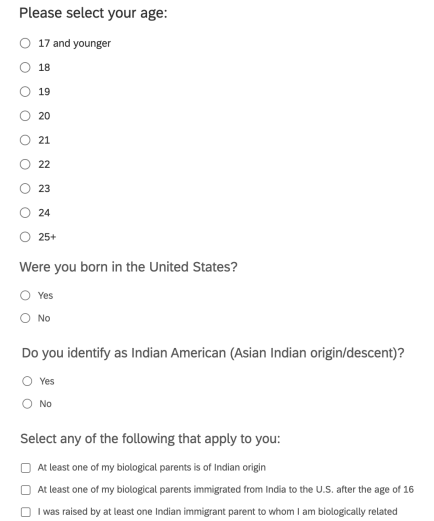
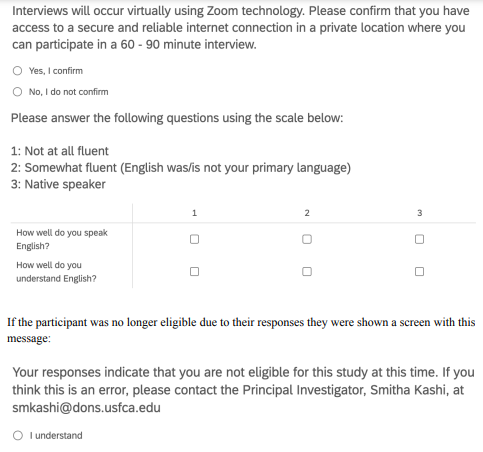
Appendix D: Post-Eligibility Screener

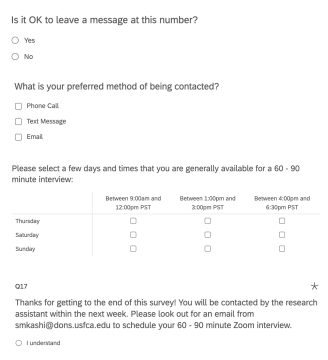
Appendix E: Consent Form

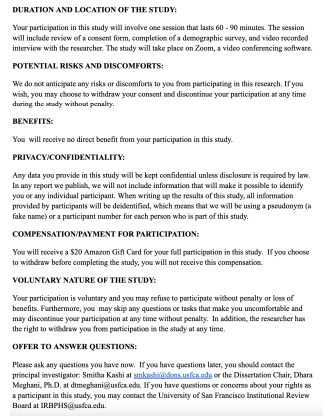

Appendix F: Interview Guide
Interview Guide:
Introduction:
Hello! Thanks for joining today. I know you have received communication from me before but just to remind you, my name is Smitha Kashi and I am a doctoral student at the University of San Francisco. I am trying to learn more about what contributes to emotional expression when individuals are young adults (18 – 24 years old). I’m also really interested in learning about this process within our South Asian community. I myself identify as South Asian and I am curious about how this developmental period has been for other South Asian folks. Today we are going to talk for about 60 – 90 minutes and I’ll have some questions to help us with this conversation. Before we proceed, do you have any questions?
Informed Consent:
As mentioned in the informed consent document provided to you earlier, we’ll be recording this interview and I will transcribe the interview later. The recording and transcription will be password protected. Anything you say to me during this time will be kept confidential unless I hear of any concerns related to the safety of minors, yourself, or other vulnerable people. When I write up the results of this study, all information provided by participants will be deidentified, which means that I will be using a pseudonym (a fake name) or a participant number for each person who is part of this study.
Many of the questions I will be asking you will ask you to share personal experiences around important relationships in your life such as your parents and your peers. As these questions are personal, they may cause some emotional discomfort. If you are experiencing any distress you can ask the researcher to stop the interview or choose not to answer any questions at any time during the interview. In the case that you choose to end the interview, you will not be penalized for that decision. Do you have any questions around the information I just shared with you?
Interview Questions:
Rapport Building Questions:
Ok, we’ll get started first with some questions about your family of origin, meaning the people who you grew up around.
– Can you tell me a bit about your family?
– Were you raised by both your parents?
– Where in the U.S. were you raised?
– Do you have siblings?
– (IF SO): where are they now? Ask about birth order
Thanks for sharing that information. I have a few questions to help me get to know more about you before we go back to talking about your parents’ experience immigrating to the US.
– Who do you currently live with?
– Are you working/student, etc.?
– How would you describe your identity?
Next , I’d like to ask you to share what you know about your parents’ move to the U.S. from India.
[some probing questions that may be helpful to support their narrative around this]:
- What were some of the reasons that your parents immigrated to the US?
- Around what time in their lives did your parents immigrate?
- Where in India did your parents’ families live?
- Where in the U.S. did your parents settle? Is this where they still live?
- Where were you born? About how many years after they immigrated did your parents have you?
What do you remember about your parents’ approach to parenting while you were growing up?
- Probe – For example, how important was it for them to pass on their Indian values and culture?
- Probe – What are some ways that they passed on the Indian values and culture (if they did)?
- Probe – How strict do you feel your parents were in their approach to parenting and discipline?
- Probe – How warm or supportive did your parents feel in their parenting approach?
I’m wondering if you can now talk a bit about how you identify ethnically. What does being [insert identifier(s)] mean to you? There are no right answers here, but since this term can mean different things for different people, I’m wanting to know how you experience this identity.
[Listening to Answer].
Thanks for your answer(s). It’s helpful for us to have this context about your family and cultural background as we move into the next part of this interview.
First, I’m just going to ask you if you can think for a bit and talk about what comes to mind when you hear the word “emotions.”[PAUSE – Waiting for an Answer].
Now, I’d like to start talking about how you express emotions. I’m really curious about how you expressed your emotions growing up. [PAUSE; let them answer if they are ready to, otherwise move forward with examples]
Sometimes it’s helpful to think of a specific time when you were with your family and you really wanted to tell them something. I’ll be guiding you through some questions to help with this discussion, and you’re welcome to add anything else that comes to mind even if I don’t ask about it directly.
Emotional Expression: [Read]: How you communicate your emotional state or attitude verbally or nonverbally.
1. Think of a time when you felt a really strong emotion or had an intense experience when you were around the ages of 14 – 17. It could be something that was really positive or negative. Could you describe this experience for me? [pause] Did you share this experience with your parents?
a. If Yes:
i. How did you feel after you told your parents?
b. If No:
i. What was the reason you didn’t?
2. Can you talk about how you expressed your emotions with your parents around the ages of 14-17?
a. How comfortable did you feel expressing your emotions around and to your parents?
b. Can you describe some ways in which you expressed your emotions? [If they are not sure what you mean, can provide this additional statement: For example some people might express them through their facial expressions or body language, and others may also express emotions through words and conversation.]
c. Were there emotions that you felt more comfortable expressing than others?
3. One of the criteria for eligibility in this study is being a second-generation Indian-American whose parents immigrated to the U.S. from India. What are your thoughts on how being a child of immigrants (sub for words they use) shaped the way you express your emotions?
4. Thank you. Now, let’s talk about the relationships you had with peers while growing up. How would you describe your relationship with your peers around the ages of 14-17? [pause for answer] What about today?
5. Remember a time when there was something very challenging going on for you/your friend? Walk me through how you went about dealing with it emotionally
6. How does your culture influence how comfortable you feel sharing your emotions with your friends and peers?
a. Do you remember seeking friendships with individuals that shared in certain identities as you (culture, race, sexuality, gender, etc)?
7. What do you believe are the most influential factor(s) that shaped how you express your emotions today? [If probe is needed: What are some of the ways in which you learned about emotions or about how to share your emotions with others?]
8. Were there aspects about emotions or emotional expression that you wish were emphasized more or less by your parents or your friends?
9. What advice would you give to other second-generation South Asian individuals who might have had a similar experience to yours?
Appendix G: Resource List
General Resources:
1. National Suicide Prevention Lifeline
2. Better Help – Therapy
3. National Institute of Mental Health
Asian-American Resources:
1. The National Asian American Pacific Islander Mental Health Association
2. Asian American Health Initiative
3. Asian American & Pacific Islander – NAMI
South Asian Resources:
1. South Asian Mental Health Alliance
2. My Sahana
3. South Asian Mental Health Initiative & Network
4. Palo Alto Medical Foundation – South Asian Health
5. The Mood Space
LGBTQ+ Resources:
1. LGBTQ Helpline for South Asians
2. National Queer Asian Pacific Islander Alliance
3. Queer South Asian National Network
Faith Based Resources:
1. Arsha Bodha Center – Hindu Resource
2. Institute for Muslim Mental Health – Muslim Resource
3. Grace Alliance – Christian Resource
4. Sikh Your Mind – Sikh Resource
5. The Buddhist Center – Buddhist Resource
6. Relief Help – Jewish Resource
7. The Secular Therapy – Atheist Resource
Family Support Resources:
1. PFlag – LGBTQ+
2. Family Members & Caregivers – NAMI
3. Mental Health Resources for Parents of Adolescents & Young Adults
Appendix H: Demographic Questionnaire
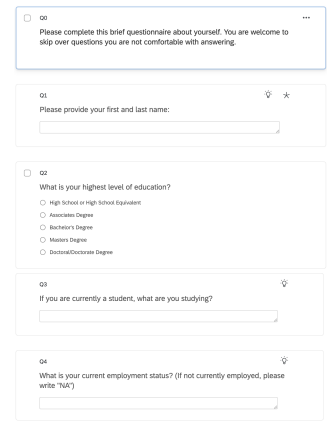


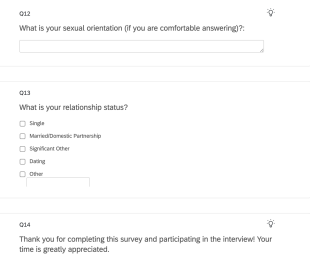
Appendix I: Final Thematic Map